What Would Synlait Be Worth to Fonterra or a2 Milk?
Speculation of a possible joint move by Fonterra and a2 Milk to buy Synlait raises a much bigger strategic question, says agribusiness expert Dr Nic Lees.
 increase font size
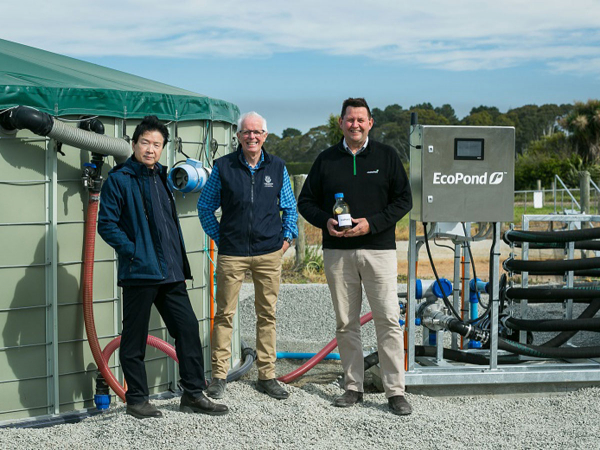 From left to right Professor Hong Di (LU), Emeritus Professor Keith Cameron (LU), Carl Ahlfeld (Ravensdown). Photo Credit: Ravensdown.
Two Lincoln University scientists, Emeritus professor Keith Cameron and professor Hong Di, have delivered a breakthrough technology with immediate benefits for the dairy farming sector to combat climate change.
Developed in partnership with Ravensdown, the new technology is an effluent treatment system that reduces the methane emissions from farm dairy effluent ponds by up to 99%.
Launched to market by Ravensdown and Lincoln University on 10 November under the brand name EcoPond, the new treatment system also slashes the amount of E.coli in the treated effluent, reduces ammonia emissions, mitigates odour and cuts phosphate leaching losses from effluent areas into waterways by up to 90%.
Cutting greenhouse gas methane emissions has been a focal point of the recent COP26 climate summit in Glasgow, with New Zealand joining more than 100 countries pledging to reduce methane emissions by 30% over the next decade.
The EcoPond system achieves its highly significant reductions in methane emissions by adding a treatment agent iron sulphate, a safe additive used in the treatment of drinking water, to effluent ponds. Both professors hope that the greenhouse gas mitigation delivered by EcoPond will be a gamechanger for dairy farmers.
“Nearly all dairy farms use effluent ponds, which are the second-largest source of on-farm methane emissions, after cow belching,” says Cameron.
“Our development and demonstration of the new system, undertaken at the Lincoln University Research Dairy Farm, has proven that the new system is enormously effective at neutralising the methane-producing process, resulting in a 4 to 5% reduction in an average dairy farm’s overall methane emissions.
“This is hugely significant for the industry, as it provides farmers with a new tool in their toolbox to help reduce methane emissions on farm.”
EcoPond can be easily retrofitted into a farmer’s existing effluent system.
“As far as the farmer is concerned, it’s ‘plug and play’. EcoPond is doing the business while the farmer is busy milking the cows,” says Cameron.
Di says they discovered EcoPond’s efficacy in reducing greenhouse gas emissions during the development phase of their earlier award-winning ClearTech system.
“In testing the ClearTech system for unintended consequences we found that the gases we collected off the effluent in experimental set-ups indicated a reduction in methane emissions of greater than 90%.
“This was a stunning result. In science, it’s rare to achieve such a large influence on an experiment.
“So, encouraged by this finding, we tested the system using farm-sized effluent storage tanks and nervously waited to see what would happen. The result exceeded our wildest hopes, achieving a methane emission reduction of 99.9%. We’re still working on that last 0.1%. We’ll get there!”
Lincoln University Acting Vice-Chancellor, Professor Bruce McKenzie says the development of two such significant and innovative agritech solutions that can be quickly and easily applied on-farm demonstrated the value of collaborative partnerships as a means to addressing some of the world’s most pressing land-based challenges.
“Lincoln University has a long history of driving innovation in the land-based sector and has a distinctive research profile.
“Our reason for being is to discover answers to the most pressing land-based challenges, and we do this by collaborating with industry partners, universities, research centres and iwi to help shape a better, more sustainable world.
“Through our partnership with Ravensdown, two of our most acclaimed researchers have been able to develop pivotal on-farm effluent treatment systems that will have immediate and far-reaching benefits by enabling the dairy farming sector to mitigate one of the key greenhouse gases, methane, while also gaining water quality benefits at the same time.”
Speculation of a possible joint move by Fonterra and a2 Milk to buy Synlait raises a much bigger strategic question, says agribusiness expert Dr Nic Lees.

Lynnette Hudson's 30-year obsession with Pinot Noir was sparked working vintage in Burgundy, seeing how subtle changes in terroir were expressed in the glass. It was, she says, "an elightening moment in every way".
A four year trial has reaffirmed that mixing plantain into dairy pastures can help reduce nitrogen losses to freshwater while maintaining milk production and profitability, say researchers.
Twenty five secondary school students from around New Zealand recently completed a three day residential programme designed to explore career opportunities across the food and fibre production supply chain.
A Lincoln University student is set to become the first person to contest both the Young Viticulturist and the Young Winemaker national titles in one year.


Decades piloting planes has ensured vet and farmer David Hayes is focused on safety. So, after a serious accident while welding on farm, he is sharing his experience so others can learn from it.
Canterbury milk processor, Synlait Milk has confirmed Leon Fung as its chief executive officer.
OPINION: Making it easier to collect rainwater and use it to grow crops and livestock is a no brainer.
As part of its Election 2026 coverage, Rural News asked political parties how they would help pull the arable sector out of the doldrums. Here's what they said:
Farmers are being encouraged to rethink how they manage waste on farm with the launch of ruralwastesorted.co.nz, a new website bringing together practical tips, real farmer experiences and resources.
New Zealand Winegrowers (NZW) is celebrating the India-New Zealand Free Trade Agreement (FTA) coming into force today, bringing New Zealand wine improved access to one of the world’s fastest-growing economies.