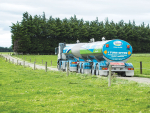
Location of pond
A site investigation before design and construction is important to ensure the pond built is structurally sound and meets regulations, says DairyNZ.
 increase font size
 Pond stirring has become more important with synthetic lined ponds.
How important is it to stir effluent ponds? More important than most farmers realise, says Midwest Machinery, maker and distributor of the Nevada pond stirrer.
The Hawera company specialises in farm dairy effluent equipment and is an accredited effluent designer through the DairyNZ approval process.
Valuable organic matter in effluent must be agitated so as to bring it into suspension prior to pumping, so a homogenous effluent mixture can be applied to pasture, the company points out.
And pond stirring has become even more critical with the advent of synthetic lined ponds and above ground tanks. But watch out for “inferior” stirrers that can damage a pond liner, the company warns.
Its shore-mounted stirrer, with a pond liner protection kit, averts liner damage. “Nevada shore-mounted electric stirrers are rigidly mounted on a substantial foundation, eliminating the risk of harm to a pond.”
All the sediment in a lined pond must be mixed into the effluent to allow pumping out. The Nevada Typhoon propellor, “which quickly creates a strong horizontal flow across the pond, brings all solids into suspension”.
The stirrer’s depth and angle can be adjusted to ensure no areas are missed. A rack-and-pinion hand winch provides stepless adjustment onshore.
“Many farmers have installed elaborate and expensive separation systems, only to find they still need a stirrer to mix the sludge accumulating in their pond,” says Midwest Machinery.
“The best time to install a stirrer is when the pond is built. It is easier and better to avoid sludge accumulating than to try to remove a build-up. In many instances farmers would have been more prudent to install a stirrer and not a separator. With Nevada pond stirrers it is acceptable to leave the solids in the effluent stream.”
Safety and reliability are a standout with the Nevada gear, Midwest Machinery says.
Tel. 0800 464 393
A site investigation before design and construction is important to ensure the pond built is structurally sound and meets regulations, says DairyNZ.

With pressure on farmers to tidy up their act in effluent handling, Viking Containment’s timing in introducing a new liner for storage ponds or lagoons couldn’t have been better.
A new means of monitoring change in the level of effluent ponds is now available to Southland farmers.
Safety around effluent ponds is essential. In general the Health and Safety in Employment Act (1992) rules bear on ponds’ operation rather than their design and construction, so they affect the pond owner more than the designer or builder.
A WELL-DESIGNED and managed effluent pond is efficient and reduces risk to a farm, says DairyNZ. It also increases flexibility: you can determine when to irrigate at a time that suits.


Farmers have until the end of this week to help shape DairyNZ’s future focus.
Wayne McNee, chief executive of AgriZeroNZ, has resigned and will leave the organisation on 15 January 2027.
The New Zealand dairy sector set a record in the 2025/26 season, producing more than two billion kilograms of milksolids for the first time.
Milk powder prices are continuing their merry run, firming up a potential $10/kgMS farmgate price this season.
Teachers are welcoming the outgoing Government’s U-turn allowing agriculture and horticultural science to remain a standalone Year 11 subject.
Outgoing ACT MP and dairy farmer Mark Cameron says Saturday’s election result reflects voters deeply impacted by the cost of living.