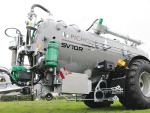
Pichon Adds SV10R and SV14 to SV Slurry Tanker Range
French manufacturer Pichon has expanded its SV slurry tanker range with the launch of two new models.
 increase font size
 Great Plains sub-soiler.
Designed for deep vertical tillage, the Great Plains inline sub-soiler, marketed by Norwood, shatters yield-robbing compaction layers created by horizontal tillage tools such as ploughs and discs.
With a working depth of 300 to 400mm, the autumn tillage tool resets the soil profile and maintains uniform soil density with minimal topsoil disturbance.
Its high-tensile frame has 9.5mm walled tubing for added strength and durability. Units are available in 700mm (6 shank) or 750mm (5 shank) spacings.
At the business end, a no-till, winged point 250mm wide is used ahead of a 19mm thick no-till shank. The no-till point minimises surface disturbance and the wings create lift and maximise shatter at the sub-surface levels.
Rearwards of the shanks, 25mm) solid rods carry 410mm diameter berm conditioners to help provide a level surface, enabling single-pass seedbed preparation.
Overload protection against sub-surface obstacles like large stone rocks or timber is ensured by auto-reset shanks with a trip force of 1360kgs.
Depth control is set by large diameter depth wheels with screw jacks for easy adjustment.
French manufacturer Pichon has expanded its SV slurry tanker range with the launch of two new models.

Norwood has announced the opening of a new Tasman dealership at Richmond near Nelson next month.
Distributed in New Zealand by Norwood, Pichon has expanded its SV effluent tanker range with the addition of the new SV12R single-axle and SV15R tandem-axle models.
Having taken over from the previous distributor, who represented the brand for two decades, Landini New Zealand marks the beginning of a new distribution deal with Norwood, with a first look at Fieldays.
A well-known name is being showcased at Fieldays as Palmerston North-based Norwood takes over the distribution of the Landini tractor brand.


Halter has launched Mav, an AI farming assistant that lets dairy farmers ask questions about their herd and pasture and get answers drawn from the data the company’s collars already collect.

OPINION: At first glance it appears that Father Christmas has delivered the rural sector good tidings, with most pundits predicting the return of the centre-right coalition.
For 15 years, Glenda Rees has travelled from Gore to Awarua, often several times a week, to keep watch over one of the country’s rarest birds.
With some farmers opposing a government-industry partnership set up to develop methane reducing products, one NZ company claims that it already has a product on the market.
During the nesting season, from September to December, industrious starlings can quickly build nests in the darker areas behind tractor and vehicle, usually close to hot engines, typically resulting in localised damage or in some cases complete write-offs.
The meat processing industry is much more collegial than it was in the past and is now more focused on common goals.