Why Now Is the Time to Plan Farm Succession, Findex Says
OPINION: Succession and long-term planning are perennial topics because it is perpetually sidelined on busy farms.
 increase font size
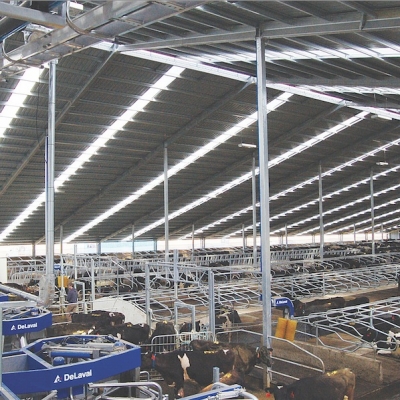
THE OWNERS of the world’s largest robotic farm under one roof, Aad and Wilma van Leeuwen, say they were particularly attracted to the DeLaval robotic milkers due to the Herd Navigator technology.
The van Leeuwens, who by Christmas will be milking 1500 cows with 24 DeLaval robots, say the information made available by Herd Navigator would help them make crucial decisions.
The aim is to have 12 robots operating with Herd Navigator by the end of next year. The farm in South Canterbury is a $22m investment.
The scale of the installation was a challenge in itself, with 2.5km of milk lines in the barn alone.
Added to this, the barn had been designed already, meaning the DeLaval team needed to work with what had been created. Ideally, the barn would have been wider, so they needed to adapt to the building.
DeLaval automatic milking systems technical specialists Jon Nurse and Adrian Garner worked with the global planning department in Sweden and kept communication lines open about the size of the building and how things could fit in it.
The barn has several unique features, including the milk transport system. Because of the large number of robots, getting the milk to the vat proved complicated.
They came up with eight lines, split into four areas on each side of the barn. This means that at any one time there will be at least one VMS able to milk 24/7.
Another feature is the centralised chemical line. Because of the sheer volume of robots needing chemical (acid, alkaline and teat spray) to operate and clean, the chemical goes straight to the robot rather than being manually directed.
It is the first centralised vacuum system in Oceania and creates efficiency of power use, reducing capital costs and the number of vacuum pipelines needed.
The same system will be installed for colostrum milk, which will be delivered to a central point and pumped from there.
The computer network was also tailored to meet the needs of the van Leeuwens, with six PCs installed for 24 robots, as opposed to the usual one PC for up to eight robots. This is to provide an enhanced service for users, with all screens able to tap into the same database.
The van Leeuwens themselves say the workmanship is second to none.
“It was breaking it down into components and planning each component of the system. The volume has been the big trip. Part of the brief from Aad was that the aesthetic look was important. It was a massive challenge doing the pipework,” Garner says.
“We are immensely proud. A lot of what we are trying to do is make things work as well as they can, to get the best result for Aad,” Nurse says.
The van Leeuwens already have Lely robotic milkers installed at another farm, but went with DeLaval for their new barn.
Wilma van Leeuwen says what won them over was the prospect of using Herd Navigator.
“Costs were pretty similar and we know robots are robots and will do a good job. Both Lely and DeLaval have a good reputation but what attracted us was Herd Navigator. We feel the manager needs a bit of assistance on such a large scale farm.
“We like a challenge and thought it would be interesting to compare. We’re not afraid to step outside the square. It keeps competition in the market.”
OPINION: Succession and long-term planning are perennial topics because it is perpetually sidelined on busy farms.
Farms across the upper North Island are trialling different pasture mixes as part of a research programme that aims to build greater resilience into farming systems.
Election years are always a concerning time for farmers, according to DairyNZ chair Tracy Brown.
Matt Collier, Probiotic Revolution, says calves will drink a lot of milk once-a-day with their probiotic Calf Xtreme.



Now in its fourth year, the 2026 Fencing Industry Awards, formed part of the proceedings of the FCANZ Conference, held in Nelson during August.
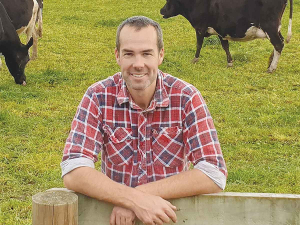
DairyNZ deputy chair Cameron Henderson has been re-appointed unopposed for another term.
OPINION: The stats speak for themselves.
Farms across the upper North Island are trialling different pasture mixes as part of a research programme that aims to build greater resilience into farming systems.
Election years are always a concerning time for farmers, according to DairyNZ chair Tracy Brown.
The Ballance Farm Environment Awards are coming to the West Coast of the South Island.