Teat spray price drop
FIL, the animal health and dairy hygiene subsidiary of GEA Farm Technologies, is dropping the price for its chlorhexidine teat spray products.
 increase font size
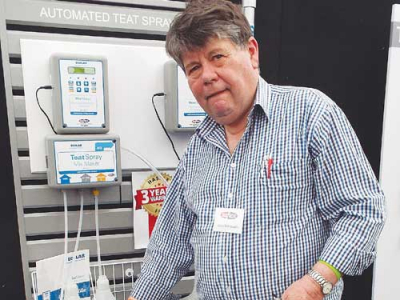 Mark Bell-Booth, Saflex Ltd.
A 2011 study of teat spray use on 300 New Zealand farms discovered that 60% of dairy farmers were either mixing or using the products incorrectly.
Much of the poor practice centred on incorrect dilution rates and storage of mixed product.
Both problems are now addressed by a new device seen at the ASB Innovation Centre at Central Districts Field Days -- the Saflex MixMaker sold exclusively by Ecolab.
Spokesman Mark Bell-Booth says the device “requires only four minutes to get properly diluted teat spray onto the cow, direct from the drum, fully mixed and diluted to the correct concentration”.
An easy-to-use control panel allows the ratio of teatspray and emollient to be adjusted on the job between 5% and 30%, to allow for changes in environmental conditions. The changes can be made immediately before or during milking.
Field testing in Canterbury, on herds from 300 to 1400 cows, indicated that hot, drying winds can completely change the condition of a teat between morning and afternoon milking, and necessitate changes to the teat spray ratios.
Managers at the trial sites said they found it much easier to tweak the MixMaker to adjust the percentage of emollient in the spray mix to counter possible teat damage during milking; changes to the texture of the product were seen just minutes later.
The system can be retro-fitted to the inlet tube of an existing vacuum or electric teat spray system, or added to an automatic or walk-over system.
FIL, the animal health and dairy hygiene subsidiary of GEA Farm Technologies, is dropping the price for its chlorhexidine teat spray products.

An intelligent new Auto Mix + Spray unit from GEA’s FIL division is said to set a gold standard in teat spraying, providing farmers with an accurately mixed solution applied ‘fresh’ at every milking.



Forestry Minister Todd McClay has today congratulated the winners of the 2026 Growing Native Forests Champions Awards at Fieldays.

The Government has announced $60,000 to provide one-off grants of $1,000 to each of the 60 New Zealand Young Farmers (NZYF) clubs across the country.
New Zealand’s rural sector has once again demonstrated its generosity, with the second Rural Industry Leaders Dinner, Debate and Auction raising an impressive $400,000 for the Rural Support Trust.
There has been another twist to the Federated Farmers annual election fiasco.
Analysis of decades of research has revealed the implementation of good farming practices plays a critical role in reducing nutrient losses to improve freshwater outcomes.
Yesterday the Government used the opening of Fieldays to announce a major investment, as part of its Land Use Flexibility package, to support a more productive and sustainable future across six sectors including dairy.