Hustler Launches Third-Gen Unrolla TX235 Bale Feeder
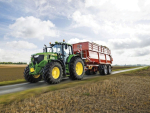
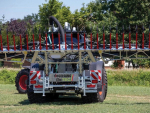
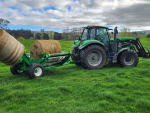
Well known for its extensive range of feeding solutions, Hustler has introduced its third-generation Unrolla TX 235, two-bale, self-loading bale feeder.
 increase font size
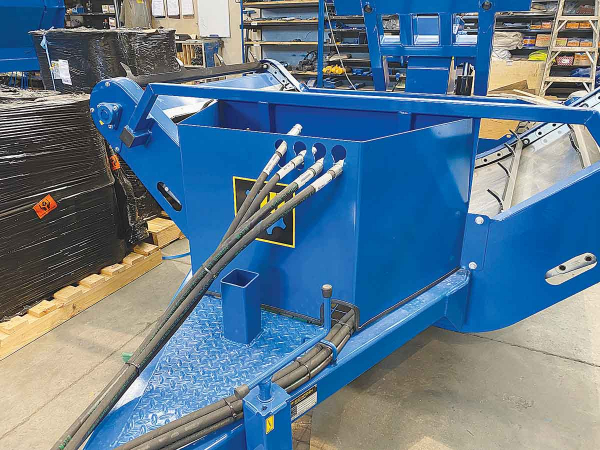 Drawbar mounted rubbish bin.
Mark Daniel reports on McIntosh's impressive Double Bale Feeder.
You don't have to travel very far to find a farm using McIntosh feeding equipment, and those doing so report a robust construction, clever engineering and a long working life.
The Double Bale Feeder builds on this reputation and offering the ability to deal with round or square bales.
The chassis consists of two box sections running through the bale cradle to increase overall strength, while the layout also lowers the overall loading height and centre of gravity, to promote safe use on hillsides or sloping ground.
A 315mm overhang on the discharge elevator, combined with tyres kept close to the chassis means that delivered feed is not “run over” and contaminated, while a choice of wheel settings allows safer operation on difficult terrain or the option of fitting larger tyres. As standard, machines are supplied with 11.5 x 15.3 tyres, a detail that helps to reduce rolling resistance, making towing easier in poor conditions.
An over-dimensioned lifting arm can deal with the heaviest bales, while also being able to carry a second bale to the feeding area. The design features twin lift rams which gently lower the bale onto the unrolling cradle and helps prevent damage to the feeder bars. The unrolling cradle uses a zinc-plated, 12,000 lb rated chain, with slow running shafts utilising bronze bushes for resistance to silage juice, and a greater service life. Unloading slats are manufactured from 8mm steel with integral teeth to promote bale rotation by increasing the contact area, while in the cradle aggression pins restrict bale movement to encourage the teeth to pull the bale apart.
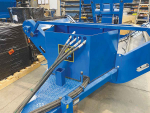
From a practical point of view the machine includes a rubbish bin, and a chequer-plated platform on the drawbar a-frame to allow the user to safely remove the film and net wrap.
Since its introduction, the manufacturer has introduced several options and redesigns to make using the feeders easier.
On the rear lifting forks, these include a third, central tine, set lower and said to be useful for dealing with soft or mis-shaped bales.
For those handling square bales, lateral extensions, each carrying an extra tine, ensure positive lifting onto the cradle, while those dealing with chop bales can specify front and rear infill panels to stop material being lost before it heads up the discharge conveyor.
In addition to the lateral extensions, those feeding squares might also option the machine with optional siderails for the bale cradle. All machines now include a larger, waste box.
Well known for its extensive range of feeding solutions, Hustler has introduced its third-generation Unrolla TX 235, two-bale, self-loading bale feeder.
A new three point linkage bale feeder that looks to upturn traditional design thinking has been launched by feeding specialist Hustler.
You don't have to travel far to find a farm using McIntosh feeding equipment, and users report robust construction, clever engineering and a long working life.
A recently introduced double bale feeder by McIntosh builds on the company's reputation for heavy duty products maintaining best practice design, engineering and production.


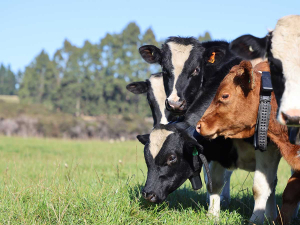
High country stations, mixed sheep and beef farms, Māori-owned farms, corporates and family operations are among the nine commercial farms taking part in the Livestock Innovation Farming Transformation programme, known as LIFT.
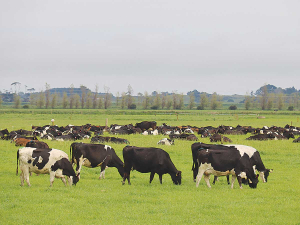
OPINION: New health and safety guidance unveiled by the Government recently provides farmers greater certainty about what is expected of them when managing risks on farm.
The National Animal Welfare Advisory Committee (NAWAC) is seeking public feedback on proposed changes to the Code of Welfare for Rodeos.
A New Zealand initiative supporting farmers to restore the health of grazing landscapes has received international backing through the Regenerative Fund for Nature, a global collaborative fund supporting regenerative agriculture and the communities that produce natural fibres for the fashion industry.
Combine premium New Zealand products, blend in a family ritual and what do you get? A world-class functional drink.
Entries are now open across eleven regions for the 2027 New Zealand Dairy Industry Awards (NZDIA).