
El Niño Warning: NZ Farmers Urged to Plan Fert Early
Plan ahead and be patient. That’s the message to farmers and horticulturalists from the chairman of the NZ Agricultural Aviation Association, Kent Weir.
 increase font size
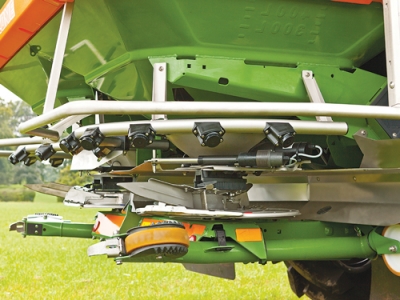 Amazone fertiliser spreaders.
Amazone feriliser spreaders, well respected for many years, have won their maker a Machine of the Year Award at the recent Agritechnica show.
The Amazone ZA-TS featured the new Argus Twin lateral technology where each disc uses radar sensors above each unit to monitor the spread pattern, automatically adjusting the delivery if any deviation is detected from the required setting.
Mounted rigidly and with no moving parts, the system is said to be robust and maintenance-free in what is typically a harsh environment. The system will compensate for changes in spread pattern that might be caused by fertiliser quality, start-off speeds or braking, travelling on slopes, or even when spreader vanes are worn.
The technology will operate during border spreading or section control and aims to ensure the most effective use of the fertilisers and easy operation.
Argus Twin can be optioned on all mechanically or hydraulically driven machines in the ZA-TS range and is said to complement other automated technologies such as auto-calibration and tilt-sensing, and inasmuch gives the operator the ability to set the rate and drive off.
The automated systems then check actual delivery rate against the set target. Tilt sensing detects any deviation from the centre of gravity and electric shutter control ensures an even three dimensional spread regardless of terrain.
Plan ahead and be patient. That’s the message to farmers and horticulturalists from the chairman of the NZ Agricultural Aviation Association, Kent Weir.
Amazone's ZG-TX combi spreader has been updated with several new features, centred around improved accuracy and easier operation.
When it comes to annual rebates, it's been a long time between drinks for Ravensdown shareholders.
Ravensdown has reported a net profit before tax and rebate of $50.1 million for the year ended 31 May 2026.
Fendt's 900 Vario was unveiled at Agritechnica 1995 and has since gone on to become a popular choice for farmers and contractors worldwide.



New Zealand's pest problem has reached crisis point, according to Federated Farmers' second National Pests Survey, which shows farmers are spending more money and effort on control — yet pest numbers keep climbing faster than they were two years ago.

Testing confirms H5 bird flu in a single northern giant petrel, found dead on a remote Cape Palliser beach in the Wairarapa, says Dr Mary van Andel, the Ministry for Primary Industries' (MPI) Chief Veterinary Officer.
"What's for dinner?" may sound like a simple question, but for many Kiwi parents, answering it has become a job in itself.
Fifty Eight years ago, on the 16th of August 1968, August Claas, the founder of the harvesting company and father of Helmut Claas, personally presented a Claas Senator combine harvester to Scottish farmer John Steven.
New Zealand consumers are paying more for beef mince than ever before, with the average retail price now sitting above $24 per kilogram, according to Rabobank.
State farmer Pamu has delivered its strongest operating result on record.