DCANZ Urges Next Government to Back Dairy Export Growth
Dairy processors are ready to further boost New Zealand’s export earnings but want the incoming government to match their ambition with good policy.
 increase font size
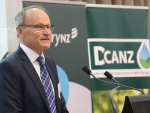
 Malcolm Bailey
The chairman of the Dairy Companies Association of New Zealand (DCANZ) Malcolm Bailey says the industry appears to be in a strong position given what is happening in the world at present.
He says it is very gratifying to see those who monitor the situation revising dairy prices upwards, but he adds that there is still a degree of nervousness worldwide about what might happen to the global economy due to Covid-19.
Bailey says last year, people were predicting that things would be a lot worse than they turned out to be and there is hope this may happen again.
“However, dairy companies would still be a bit cautious around price expectation in the coming year,” he says.
His comments come at the same time as the Ministry for Primary Industries (MPI) is projecting a 4.6% drop to $19.2 billion in export revenue for dairy products in the coming year. In its latest Situation and Outlook for Primary Industries (SOPI) it says, in the short term, dairy export prices will remain relatively constrained. It notes that although NZ will have a strong production season, it points out that milk production in the US, Europe and Australia will also be up.
At the same time, it posts a warning about the strengthening of the NZ dollar to the US dollar, saying if this continues, it could act as a drag on dairy export revenue growth.
“For farmers, these weaker prices are expected to flow through to reduced farmgate returns with the average price being $6.90 per kg/MS. This is based on the assumption that there will be no major negative shocks to commodity prices due to Covid in key NZ markets,” says the report.
Interestingly the MPI projection on the farmgate milk price is 30 cents lower that the prediction by the ANZ bank, which last week put the forecast payout for the 2020/21 season at $7.20/kgMS.
While the outlook for the dairy industry is somewhat blurred in the coming year, MPI says things should come right in 2022 and is predicting export returns in a year’s time to bounce back to what they were last season. However, there are caveats on that – especially given that the SOPI report was done before Christmas and therefore before the most recent world outbreaks of Covid-19.
Dairy processors are ready to further boost New Zealand’s export earnings but want the incoming government to match their ambition with good policy.
A former Fonterra executive is the new chair of the Dairy Companies Association of New Zealand (DCANZ).
Six industry organisations, including DairyNZ and the Dairy Companies Association (DCANZ) have signed an agreement with the Ministry for Primary Industries (MPI) to prepare the country for a potential foot and mouth outbreak.
OPINION: The Canadian government's love affair with its lifestyle dairy farmers has got it into trouble once again.


Halter has launched Mav, an AI farming assistant that lets dairy farmers ask questions about their herd and pasture and get answers drawn from the data the company’s collars already collect.
OPINION: At first glance it appears that Father Christmas has delivered the rural sector good tidings, with most pundits predicting the return of the centre-right coalition.
For 15 years, Glenda Rees has travelled from Gore to Awarua, often several times a week, to keep watch over one of the country’s rarest birds.
With some farmers opposing a government-industry partnership set up to develop methane reducing products, one NZ company claims that it already has a product on the market.
During the nesting season, from September to December, industrious starlings can quickly build nests in the darker areas behind tractor and vehicle, usually close to hot engines, typically resulting in localised damage or in some cases complete write-offs.
The meat processing industry is much more collegial than it was in the past and is now more focused on common goals.