It's The Margins That Matter
OPINION: It appears to be difficult for people who haven’t tried to run a business to understand the difference between assets and cash.
 increase font size
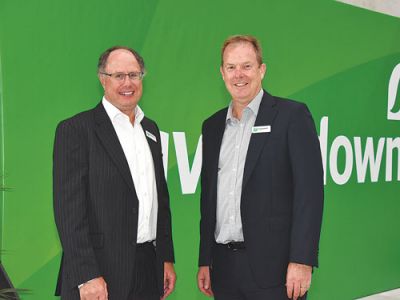 Ravensdown chair John Henderson (left) with chief executive Greg Campbell.
Fertiliser co-op Ravensdown has posted a 2017-18 pre-tax profit of $63 million, up 24% on last year.
It paid shareholders a rebate of $47 per tonne, and saw its value rise $50m over the year: equity rose from $379m to $429m.
The result was not a one-off and not just seen in financial indicators, said chairman John Henderson.
“The key thing is everything we’ve been focusing on and investing in for the last four years has been delivering returns for shareholders and building the value of the company along the way.”
“While this is a very strong financial result, Ravensdown is not here to maximise profit at the expense of our natural environment, safety or our local communities.
“Returns for shareholders take many forms including new products, expertise and technology that help them reduce environmental impact and optimise value from the land.
“Continued financial strength gave us the confidence to pay an interim cash rebate for the third year in a row and reinvest in the business to support our smarter farming purpose,” he said.
For those who bought solid fertiliser before May 31, $17.50/t of the total rebate was paid on June 8 and for fully paid-up shareholders the remaining $29.50/t will be paid in cash by the end of August.
Operating cashflow of $98m ($60m 2017) and balance sheet strength allowed the co-op to invest in the business.
Chief executive Greg Campbell said he is keen on the developments affecting the environment.
“We are determined to help... farmers manage their nutrients and we encourage good farming practice. Our aim is to help others reduce their environmental impact so we must lower our own. Being welcomed into the Sustainable Business Council, joining the Climate Leaders Coalition and reporting our carbon emissions for the first time is just the beginning.
“Society is rightly expecting more and we are expecting more of ourselves,” said Campbell.
The co-op increased its spending on R&D, including launching the ClearTech effluent treatment system which it says could reduce dairying’s fresh water use by 42 billion litres a year.
It continued its farm environmental consultancy, further developed its nutrient management advisory service and deployed its HawkEye mapping software that helps farmers comply with environmental rules.
The co-op further grew in its coated urea product N-Protect which keeps more nitrogen available to plants with less loss to the atmosphere.
Ravensdown spent $8.7m on finishing a new New Plymouth store, $5.3m on new loaders in stores and manufacturing, $2m on removing asbestos and $2.3m on health and safety.
Its Primary Growth Partnership programme, which is investigating more precise aerial spreading, is three-quarters complete. Its aim is to avoid spreading fertiliser on land where that would be ineffective, culturally insensitive or harmful to the environment. And the scheme is intended to raise pilot safety.
The Ministry for Primary Industries endorses the scheme and agrees with extending its coverage to possibly 90% of hill country which could be soil-tested from aircraft.
“I’m proud of Ravensdown’s contribution to premium food creation in New Zealand, the way we are preparing for the future and the efforts of all the team in another great result,” said Campbell.
OPINION: It appears to be difficult for people who haven’t tried to run a business to understand the difference between assets and cash.
OPINION: In the 1980s, concern was expressed in West Germany about the falling birth rate. Some simple analysis was performed by Professor Helmut Sies, physician and biochemist at Dusseldorf University. His letter ‘A new parameter for sex education’ was published in Nature in 1988:
When it comes to annual rebates, it's been a long time between drinks for Ravensdown shareholders.
Ravensdown has reported a net profit before tax and rebate of $50.1 million for the year ended 31 May 2026.
Farmer owned co-operative Ravensdown has signed a two-year naming rights sponsorship of the Canterbury A&P Show.


For the first time in a quarter of a century, Federated Farmers has something positive to say about the Labour Party’s climate change policy leading into a general election.
A warning for New Zealand seed and grain companies – be prepared for an exodus of farmers from the arable sector.
Now in its fourth year, the 2026 Fencing Industry Awards, formed part of the proceedings of the FCANZ Conference, held in Nelson during August.
DairyNZ deputy chair Cameron Henderson has been re-appointed unopposed for another term.
OPINION: The stats speak for themselves.
Farms across the upper North Island are trialling different pasture mixes as part of a research programme that aims to build greater resilience into farming systems.