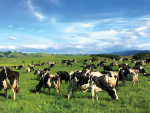
DairyNZ's Tracy Brown Flags El Nino Risk for Dairy Farms
Most dairy regions around the country have had a pretty good season so far says Tracy Brown.
 increase font size
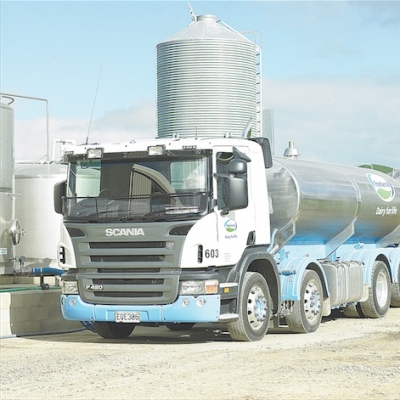
The Global Dairy Trade lift overnight of 2.6% is broadly in line with expectations, says ASB rural economist Nathan Guy.
The overnight lift was the third auction out of the last four to record a price lift.
However, by product the auction was more mixed relative to expectations, he says in his 'Quickview' outline.
"Key WMP prices rose bang in line with expectations, while the anticipated jump in SMP prices was absent (futures prices had hinted at a lift in excess of 5%). Instead, SMP prices actually fell 0.9%.
"Elsewhere, butter milk powder (up 16.2%) and anhydrous milk fat (up 4.9%) regained some of their recently lost ground. Butter prices posted a 3% increase, while casein (up 0.3%) also lifted marginally. Cheddar (down 0.8%) was the other main product we monitor to post a fall."
In terms of the price outlook, the auction result is somewhat moot given this was the smallest auction for the year, he says. ASB is sticking to its $3.90/kgMS forecast for 2015/16.
Attention now quickly turns to 2016/17. Fonterra provides its new season forecast next Thursday. And while we expect the milk price to ultimately end at $6/kgMS, Fonterra's starting point forecast for the season will be much lower.
Most dairy regions around the country have had a pretty good season so far says Tracy Brown.
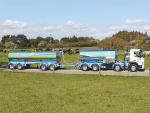
Fonterra says its interim results show continued momentum in its performance, with revenue of $13.9 billion in the first half of the 2026 financial year.
A solid recovery of global dairy prices this year makes a $9.50/kgMS milk price almost a shoo-in for this season.
Entries have opened for two awards in the New Zealand Dairy Industry Awards (NZDIA) programme, aimed at helping young farmers progress to farm ownership.
Fonterra has slashed another 50c off its milk price forecast as global milk flows shows no sign of easing.

Farms across the upper North Island are trialling different pasture mixes as part of a research programme that aims to build greater resilience into farming systems.
Election years are always a concerning time for farmers, according to DairyNZ chair Tracy Brown.
The Ballance Farm Environment Awards are coming to the West Coast of the South Island.
Most dairy regions around the country have had a pretty good season so far says Tracy Brown.
Rural leader Mark Hooper has been appointed as an independent director to the NZPork board, bringing extensive farming, governance and advocacy experience to the role.