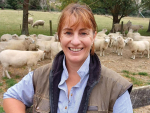
Mary Bowron Named Best Sheep and Beef Vet of the Year
B+LNZ's Wormwise veterinarian Mary Bowron has won the Best Sheep and Beef Vet of the Year Award in recognition of her outstanding contribution to New Zealand’s sheep and beef sector.
 increase font size
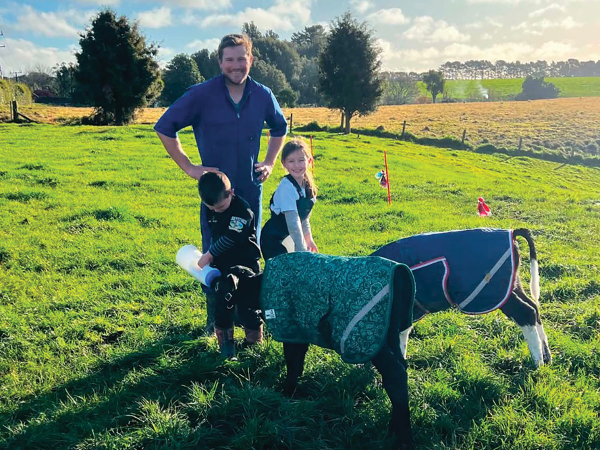 Farmer Brent Stevenson is thankful to the Bashford-Nicholls Trust.
On a farm in Tikorangi, North Taranaki, Brent Stevenson is sharemilking 1,400 cows.
His operation has recently expanded, taking on additional land, alongside new investment in renewable energy and composting barns. This infrastructure has been designed to improve animal welfare and improve on-farm efficiency.
Driving past, few would know that Stevenson got his start with a little help from two men who died long before he was born.
Growing up on a farm in coastal Taranaki, Stevenson always had a connection to the land and a natural instinct for agriculture. He received a Bashford-Nicholls Scholarship three years running, in 2007, 2008 and 2009, while completing a Bachelor of Applied Science in Rural Valuation and Management at Massey University in Palmerston North.
That financial support allowed him to focus on his studies and think seriously about the career he wanted to build.
After graduating, he went out and learned from the land itself, working across multiple regions of New Zealand, building relationships with farming families and rural businesses, understanding their operations from the inside.
From 2010 to 2016, he brought that ground-level knowledge into a financial context at National Bank, helping farming clients navigate the business side of agriculture.
Eventually, Taranaki called him home. Today he is building something lasting in Tikorangi with his wife Amy and their two children.
"You don't fully appreciate it at the time. You're just a student trying to get through. But that scholarship made a real difference. Everything I've built since, the farming, the relationships, coming home to Taranaki, it started there, studying in Palmy and having that support behind me."
Stevenson's story is one of many playing out across the region every year. And it all traces back to a decision made more than a century ago by two neighbouring farmers who simply loved their land.
Claude William Nicholls and James Dawson Bashford were born in 1880, neighbours in rural South Taranaki, five kilometres apart.
In an era when it was common practice to leave a farm to family, they each chose to do something different. They formed trusts so their land would keep giving long after they were gone, with the proceeds funding the next generation of agricultural and veterinary leaders in their region.
Last year, the Bashford-Nicholls Trust transferred $14 million in assets to Taranaki Foundation, marking the largest single transfer of trust assets in New Zealand's community foundation network.
The transfer more than doubled Taranaki Foundation's funds under management, from $13 million to $27 million, making it the third-largest community foundation in New Zealand. The funds are now invested locally through Craigs Investment Partners in Taranaki.
This year alone, the trust is supporting 66 undergraduate students, two masters students and four PhD candidates pursuing careers in agriculture and veterinary science. It also co-funds the PIVOT Award in partnership with Massey University.
"If you look at the original legacy, it was nearly 100 years ago," says Josh Hickford, chief executive of Taranaki Foundation.
"Our children, and their children, will still be telling this story. That's what we're here to protect and grow."
B+LNZ's Wormwise veterinarian Mary Bowron has won the Best Sheep and Beef Vet of the Year Award in recognition of her outstanding contribution to New Zealand’s sheep and beef sector.
With lambing underway in many regions, Beef + Lamb New Zealand is encouraging farmers to put together a wellequipped lambing kit to help minimise lamb losses, particularly in bad weather.
Researchers at Massey University are using a special piece of scientific equipment to improve the measurement of greenhouse gas emissions from pasture soils.
Interest in agritech and production animal systems has prompted Massey University's School of Agriculture and the Environment to new majors to its popular animal science degree.
Testing confirms H5 bird flu in a single northern giant petrel, found dead on a remote Cape Palliser beach in the Wairarapa, says Dr Mary van Andel, the Ministry for Primary Industries' (MPI) Chief Veterinary Officer.

B+LNZ's Wormwise veterinarian Mary Bowron has won the Best Sheep and Beef Vet of the Year Award in recognition of her outstanding contribution to New Zealand’s sheep and beef sector.
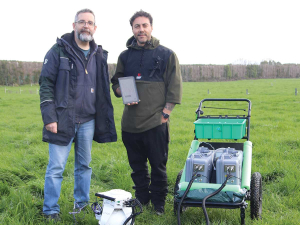
Researchers at Massey University are using a special piece of scientific equipment to improve the measurement of greenhouse gas emissions from pasture soils.
More signs of a booming kiwifruit sector.
OPINION: David Seymour and James Meager's plan to make it easier for farmers and orchardists to operate drones can best be described a 'courageous' move.
New Zealand wool is reaching new heights as air filtration companies move away from synthetic products to biodegradable alternatives.
Opuha Dam's ability to protect South Canterbury communities from major flooding has taken a significant step forward, with Opuha Water Limited (OWL) successfully commissioning a new outlet valve capable of releasing record volumes of water from the dam ahead of a weather event.