NZ Red Meat Exports Hit $867m in August, Up 23%
New Zealand's red meat and fifth-quarter exports reached $867 million in August, up 23% on the same month last year, as stronger returns lifted earnings across all major markets.
 increase font size
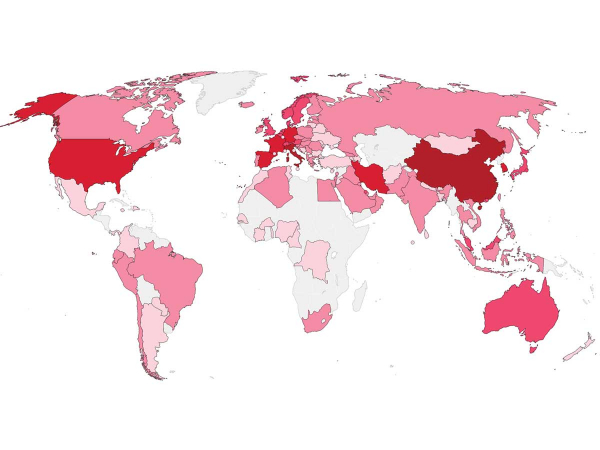 With over 130,000 cases worldwide Coronavirus isnow a pandemic. Dark areas have more than 10,000 cases.
Covid-19 is forecast to strip more than $1.3 billion dollars off New Zealand’s primary exports in the coming year, including $390 million off dairy exports.
This latest revelation comes in the Ministry for Primary Industries latest Situation and Outlook Report, released late last week.
In December MPI were forecasting that primary exports for the year ending June 2020 would be $47.8 billion – now this has been reduced to $46.5 billion, a mere 0.5% up on the 2019 total. It is also warning of further downward revisions. The report came out the day World Health Organisation declared coronavirus a pandemic.
The report states that while the geopolitical tensions on trade such as Brexit and the US-China trade war have eased somewhat, coronavirus has added new uncertainty for NZ primary exporters. It notes that the seafood and forestry sectors have been particularly badly hit. But it points in the last month dairy commodity prices have softened and the average price on the GDT fell 7.5%.
It says there has been weakness in milk powders, butter, and anhydrous milk fat. However, despite the disruptions in Chinese markets, North Asian buyers have continued to be active in recent auctions, with volumes traded higher than at the same time the previous year. It adds that prices for cheese and casein have continued to strengthen.
MPI predicts that continued declines in key commodity prices will impact farm gate milk price payouts but it says given the strength of current export prices, strong payouts are still likely and will continue to support dairy farmer profitability this season. It say an average payout of $7.15/kgMS is likely.
Fonterra will announce its half-year results this week: coronavirus is likely to have an impact.
Accoriding to MPI, while revenue from the dairy sector is down on the December forecast, it is still ahead of the previous year and is expected to earn about $19.2 billion. The report also notes that despite the drought in the major dairying regions milk production for the first eight months of the season was up by point five of a percent.
Meat and horticulture exports have also taken a hit with revenue from meat down by $220 million and horticulture by $110 million.
The as yet unknown factor says the report is the fate of the NZ dollar which has already weakened since the beginning of this year. MPI says should the weakening in our key agricultural commodity prices continue to worsen, they would expect further adjustments in the NZ$ to help offset some of these effects for primary sector exporters. And MPI warns further revisions downward in future forecasts are likely.
New Zealand's red meat and fifth-quarter exports reached $867 million in August, up 23% on the same month last year, as stronger returns lifted earnings across all major markets.

Meat Industry Association data, released alongside the Red Meat Sector conference in Wellington, shows export value climbing across the US, China, UK and Canada.
OPINION: The stats speak for themselves.
Testing confirms H5 bird flu in a single northern giant petrel, found dead on a remote Cape Palliser beach in the Wairarapa, says Dr Mary van Andel, the Ministry for Primary Industries' (MPI) Chief Veterinary Officer.
The apple sector is working with the Government to unlock access to two key markets that could bring millions in revenue for apple growers.



OPINION: Making it easier to collect rainwater and use it to grow crops and livestock is a no brainer.

As part of its Election 2026 coverage, Rural News asked political parties how they would help pull the arable sector out of the doldrums. Here's what they said:
Farmers are being encouraged to rethink how they manage waste on farm with the launch of ruralwastesorted.co.nz, a new website bringing together practical tips, real farmer experiences and resources.
New Zealand Winegrowers (NZW) is celebrating the India-New Zealand Free Trade Agreement (FTA) coming into force today, bringing New Zealand wine improved access to one of the world’s fastest-growing economies.
New Zealand’s red meat sector has welcomed the India-New Zealand Free Trade Agreement taking effect, which removes India’s 33% tariff on New Zealand sheepmeat.
More than 95 per cent of New Zealand’s forestry and wood exports to India can now enter tariff free as the New Zealand-India Free Trade Agreement comes into force today.