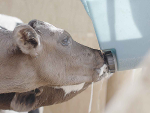
Calf rearers say goodbye to leaky teats, poor feeder fit
Leaky teats and poor feeder fit are now a thing of the past for calf rearers - thanks to the Thriver range of calf teats from Skellerup.
 increase font size
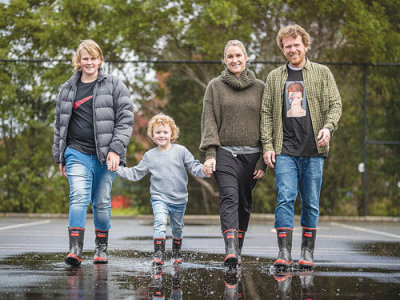 The Jack family from left to right Ethan, Nixon, Melissa and Dave with their Reb Band gumboots.
The maker of revered Kiwi Red Band gumboots is this year celebrating 60 years in production.
Skellerup national manager footwear, Perry Davis, says Red Bands were the first short boots ever made in New Zealand if not the world.
“Traditionally gumboots have always come up to just below the knee,” Davis says.
“No-one is quite sure who at Marathon Rubber Footwear – the forerunner of Skellerup -- had the idea to create a shorter boot but in 1958 the new concept was tried.
“The first Red Band gumboots rolled off the production line on October 21, 1958 and was an instant hit.”
Sixty years later these gumboots are still a staple in most rural NZ households.
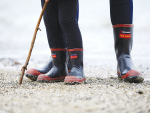
Natural rubber compounds with built-in UV inhibitors withstand our harsh environment, and a heavy-duty non-clog cleated sole plant the wearer’s feet.
And they have heavy-duty cotton canvas bonded to the rubber to give the boots strength, flexibility and protection.
Red Band gumboots were made at Skellerup’s Woolston factory in Christchurch until the late 1980s. Today the boots are made in the company’s new factory in Jiangsu, China.
“They are still hand-made to the original specifications and formulations of 60 years ago,” says Davis. “Each Red Band is made up of 19 individual components with at least six different rubber formulations used in every boot.”
Leaky teats and poor feeder fit are now a thing of the past for calf rearers - thanks to the Thriver range of calf teats from Skellerup.
Rising sales of dairy consumable products helped Skellerup deliver a record net profit of $48 million last financial year.
It's a change of scenery, customer and supply chain for Skellerup’s incoming agri division head, Hayley Gourley.
Dairy rubberware supplier Skellerup is giving its support to I Am Hope, a community group.
Filling the vat with the best milk you can produce is a financial advantage, says milking liner maker Skellerup.



Testing confirms H5 bird flu in a single northern giant petrel, found dead on a remote Cape Palliser beach in the Wairarapa, says Dr Mary van Andel, the Ministry for Primary Industries' (MPI) Chief Veterinary Officer.

"What's for dinner?" may sound like a simple question, but for many Kiwi parents, answering it has become a job in itself.
Fifty Eight years ago, on the 16th of August 1968, August Claas, the founder of the harvesting company and father of Helmut Claas, personally presented a Claas Senator combine harvester to Scottish farmer John Steven.
New Zealand consumers are paying more for beef mince than ever before, with the average retail price now sitting above $24 per kilogram, according to Rabobank.
State farmer Pamu has delivered its strongest operating result on record.
Four years since it was first detected in New Zealand, researchers and growers now know much more about management of maize pest fall armyworm (FAW).