Pāmu Braces for $30m Hit From Rising Farm Costs
State farmer Pāmu is bracing for a $30 million hit from soaring farm input costs this financial year.
 increase font size
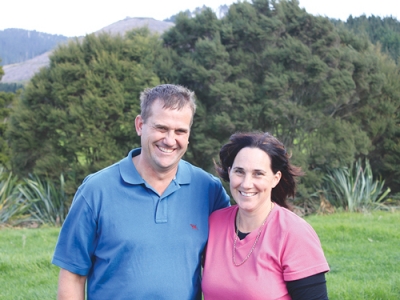 Greig and Rachel Alexander.
If you asked the average Queen Street office worker to describe a high input, high output farm they’d probably describe an operation on the flats whose owners relied on PKE and thought little about the environmental impact of their farm.
This year’s supreme winners of the Northland Ballance environmental awards, Greig and Rachel Alexander, have done exactly this on their 486ha mixed function property in Pakotai, a rural community 50km northwest of Whangarei.
The couple run Waikopani Holdings, an operation that combines a radiata, eucalyptus and lusitanica farm forestry block with a high input dairy farm and an intensive dairy beef farm. Of the 486ha, 150ha is river flats used for drystock.
Despite this the Alexanders run 2.8 cows/ha – 0.3 cows more than the regional average, and produce 183,000kgMS per season.
They do this without pugging paddocks even though cows are usually resting on a steep slope most of the time, with the property resting on Waiotira soils, well known for draining poorly and being very errosion prone, especially during winter.
Alexander attributes this to feeding policies, the main reason the couple have worked towards a high input, high output system. “If cows are full when they go onto a paddock they’re just going to find somewhere to lie down. They only tend to move about when they’re hungry.”
Animals get fed 4% of their liveweight on a daily basis during spring, the rest coming from a mixture of pasture, maize silage, clover silage and PKE, and supplementary feed given on a feedpad.
While system five operations traditionally import 25-50% of the cow’s daily energy input, the Alexanders have managed to do this while only importing 10% of their budget, largely in the form of PKE. Supplementary protein requirements are instead made up with red clover silage grown on 13.5ha of the farm.
They looked for an alternate supplement source after the PKE price hikes and supply shortages in the post-2011 summer droughts in Northland and Waikato pushed demand for PKE much higher than supply.
The couple recognized the danger of relying on an energy source outside their control and found an alternative in red clover, with protein levels of 20-22% and a yield of 16-18 tonnes DM/ha. Alexander says red clover has proved to be a strong performer, growing well in the summer despite facing two droughts and two substantial floods in three seasons.
To protect crop cover stock are kept off the field, with the couple taking four cuts off the crop each season between October and April, four-six weeks after a round of weed control.
Clover is fertilised after each cut with a focus on potassium and they do herbage tests on all crop cuts to see if any other supplements are needed to prevent mineral deficiencies. The clover is also a useful nutrient source for other crops.
Plant roots have nitrogen-fixing nodules that take nitrogen from the atmosphere and fix it in a stable form in the decaying plant tissue. Alexander says this can dramatically reduce the amount of nutrients for maize crops, something they calculate by taking 600mm core soil samples and running results through the crop modeling software Amazin.
Regularly taken soil samples are used to track soil fertility and nutrient levels and ensure effective fertiliser use.
Meanwhile the farm’s forestry blocks and high intensity beef farm also require care.
Beef calves are sourced from the dairy farm and from sales and are likely to be the operation’s top performers this season.
While the dairy payout is low, beef prices are staying strong and may stay 20-30% above historical averages, Rabobank director of dairy research for NZ and Asia, Hayley Moynihan, predicts.
The couple raise stock to 100kg before sending them to the beef unit. They grow beef to target weights averaging 460kg, which takes around 20-22 months.
Helping with the farm’s planting is Alexander’s father, Bruce. He has given sage advice on plantation planning. “Dad always said that for forestry you need to harvest the trees economically so it’s no good putting them on your steepest, most remote corners.
“With all our plantings we actually put in tracks before we plant so that the infrastructure is there when it is time to harvest.”
State farmer Pāmu is bracing for a $30 million hit from soaring farm input costs this financial year.
Farms across the upper North Island are trialling different pasture mixes as part of a research programme that aims to build greater resilience into farming systems.
Developed in Australia and launched in 2021, John Deere’s See & Spray Select System uses camera-based green-on-brown technology to identify living green plant matter in fallow paddocks and apply herbicide only where it is needed.
OPINION: Since when did one and one make three? Who didn't smell an elephant-sized rat when our leaders decided to give $60 million to save the cement factory in Northland?
New Zealand needs to make sure that it continues to focus on its own food security, according to HortNZ board member and blueberry grower Dermott Malley.


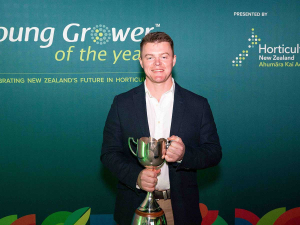
The potato industry is celebrating the success of two rising stars - James Blair, the 2026 Young Grower of the Year and runner-up and innovation award winner, Amber Davy.
Twenty-eight emerging leaders from across the horticulture sector spent two days last month learning valuable skills and connecting with industry experts.
There are five entrants in this year’s Young Horticulturist of the Year, competing in a series of technical, practical, business and leadership challenges.
A seasoned horticulturist has been appointed to deliver the Apple Action Plan, a key initiative of the India-New Zealand Free Trade Agreement.
New Zealand's citrus growers have been told to compete on the value built into their fruit rather than the volume they grow.
Hawke's Bay fruit growers are being reminded of the need to prepare for whatever the El Niño weather system may bring in the coming months.