He was still pondering that thought 20 years later, when a colleague suggested that this might be it.
"I thought, 'oh yeah, I suppose it is'."
Forty three years after he became a Research Officer at the Wine Institute of New Zealand, 36 years after he rose to Chief Executive, and 24 years after the formation of New Zealand Winegrowers saw him take the helm of a grower and wine organisation, Philip will retire from NZW on 30 June.
He says his unexpected career has been a joy, thanks to great people and a great product.
"From the very north of the country down to the deep south, and everywhere in between, there are fabulous people, working hard, creating fantastic wine doing great things for the industry and the country. It's pretty compelling."
Leading Through Crisis and Change
The past six years in particular have been "compelling" indeed, starting with the harvest-threatening restrictions of Covid-19 in early 2020, rapid work to secure and maintain essential service status, and the subsequent shipping holdups, supply shortages, destocking and oversupply, now with fuel insecurity thrown in for good measure.
"I think we've faced things in the past six years, certainly with Covid, that nobody would have ever thought we would face," he says. "It's been one thing after another."
Each of these have required Philip to work closely with growers and wine companies, with government ministers, agencies and select committees, and with his board and NZW staff.
Recognised for Lifetime Contribution
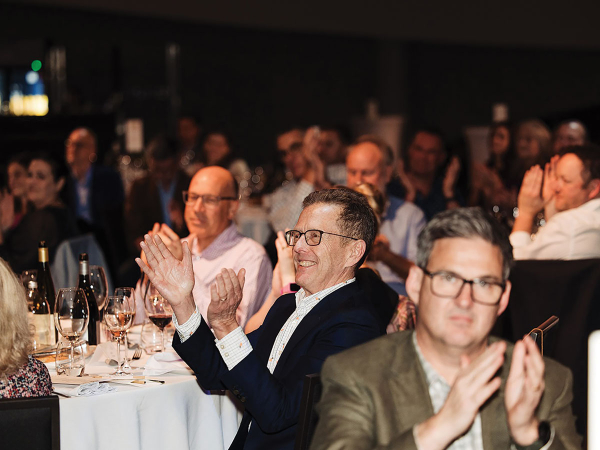
It's work that was celebrated last month, when Philip was given a Lifetime Achievement Award by London-based publication The Drinks Business, recognising his contribution to the wine industry.
Former NZW board chair Clive Jones says much of Philip's work is behind the scenes, in his relationship with government, and work with regulatory authorities, "which is often not that visible", he says. "The more I got to know Philip, the more I appreciated his depth of knowledge, and understood his significant commitment to the wine industry."
Four Decades of Change
In 1983, New Zealand had 92 wineries and 9,000 hectares, awash with Müller-Thurgau saturating the domestic market.
The industry wasn't entirely new to Philip, who grew up not far from vineyards in West Auckland, before studying for his masters' degree in geography, so he put his hat in the ring for a job with the Wine Institute, working with Terry Dunleavy.
Three years later a quarter of the country's vineyard was pulled out in the government-funded vine pull, and the industry got a new lease of life.
By the 1990s it was clear that the future of New Zealand's wine industry was on an international stage, and Philip's job was to work out how big the potential was.
In the decades since, producing vineyard has grown to more than 42,000ha and the export market to $2.1 billion at the end of last year.
NZW Board Chair Fabian Yukich says that extraordinary transformation came with burgeoning compliance, sustainability and trade relationships, all managed by NZW, and "that's an impressive achievement".
Philip brought in the right people and skills, while developing an excellent culture, Fabian adds.
Members trust the organisation to get things right, "and Philip is responsible for that".
He's worked "incredibly hard", while bringing "unwavering integrity" to his role, Fabian says.
"Why does he have such good relationships with various government ministers and people in the industry over a long period of time? Why does he have those relationships in our export markets? I think it's the values that Philips brings to the role, and his integrity and honesty... People trust him."
That's not easy, given the different perspectives in every corner of every wine region.
Philip frequently reflects that "if you've got 10 winemakers in the room, you're going to have at least 11 different opinions".
That's led to some good discussions with people over the years, "but I don't make these decisions about what to do by myself," he says. "That's what the board does."
There are as many opinions around the board table as there are in the industry, "and so there's always good discussion on things that are important".
He notes that there's a "huge variety" of business models in the industry, "and I think at times, we spend a little bit too much time thinking about what separates those business models. What unites all those business models is really what we're all about." NZW is there for the membership as a whole, he adds, "and what that means is it's always a challenge".
When asked about highlights of the past 43 years, Philip lands on the passing of the Wine Act in 2003, including his role as Special Advisor to the select committee.
"That was a really positive experience, with the Wine Act something we had advocated for, and persuaded the government of the day to progress. And it’s served the industry pretty well for the past few decades.”
The other was in 2008, in the midst of the global financial crisis and a New Zealand wine glut, fronting up to 500 growers and winery members in Marlborough about the challenges facing the industry.
“I think that meeting really validated the benefit of having a joint industry organisation; a united one that could speak to both growers and wineries,” Philip says. “That’s what we did that day. And we had a huge turnout.”
Fast forward to 2026, and there’s another challenge, with a global decline in wine sales, an oversupply of New Zealand wine, and vineyards around the country being mothballed, redeveloped or repurposed. But Philip remains buoyant.
“I think ultimately we’ll see increased production of New Zealand wine, because there is demand for our wine in key markets.” That’s not to “underestimate the current pain, because that’s very, very significant overall”, Philip says. “But if you look at what people want to drink, in terms of wine, we’re in the right place. And that’s a very good position, ultimately, for the industry to grow and prosper over the medium to long term.”
NZW’s role is to enable that.
“Why are people buying New Zealand wine in New York or Shanghai? They’re buying it not because it looks like anybody else’s, but because it’s different and special,” he says.
“Our job is helping our industry to continue to have the freedom to produce wine, and helping them to have the freedom to continue to access markets. Those things haven’t changed, and I don’t think they ever will.”
After 43 years on his toes, dealing with growers, wineries, NZW staff, government agencies and whatever crisis or opportunity is on the horizon, Philip isn’t slowing down as he approaches the finish line.
The last week of June includes Grape Days Marlborough on the Monday, a briefing for government officials on Wednesday, and a Primary Production Select Committee appearance and board meeting on the Thursday, along with the day-to-day business that floods Philip’s diary, from member calls to fuel concerns to fair trade deals.
From there his plans are as undefined as they were back in 1983. “I have no idea,” he says with a laugh. “That’s a deep concern to my wife.”