NZ Beef Mince Now Over $24/kg as Export Demand Stays Strong
New Zealand consumers are paying more for beef mince than ever before, with the average retail price now sitting above $24 per kilogram, according to Rabobank.
 increase font size
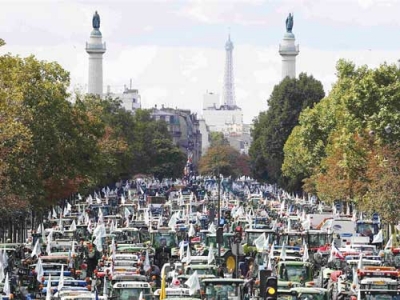 Angry French farmers with their tractors in Paris.
When French farmers are unhappy they take to the streets. Last week, 1000 tractors rolled into Paris as French farmers tried to clog up the capital’s roads in protest at plummeting food prices.
Prices for staples such as beef, pork and milk are being squashed by such as changing dietary habits, slowing Chinese demand and the Russian embargo on western products in response to sanctions over the Ukraine conflict.
French Agriculture Minister Stephane Le Foll estimates around 10% of farms in France – about 22,000 -- are on the brink of bankruptcy, together owing NZ$1.7 billion.
Last week’s protest wasn’t the first; during the last few months, protesting farmers dumped manure in cities and blocked access to roads and motorways.
Farmers’ unions have been negotiating with the Government, which in July unveiled an emergency package worth NZ$1b in tax relief and loan guarantees. But the farmers say this is woefully inadequate, as tales of farms going under and suicides hit the news.
After last week’s protest the French Government added $150m to the assistance package.
French Prime Minister Manuel Valls also promised a “break” in the environmental norms and a year-long moratorium on debt repayment by farmers.
He also announced a reduction in social charges and promised to pour more resources into helping farmers modernise and raise investment.
“Agriculture is our heritage, the identity of our rural areas,” says Valls. “Desperation is suffocating families.”
An association of European farmers, Copa, says more mass demonstrations are ahead. But more needs to be done. Copa president Albert Jan Maat says EU measures to support beleaguered farmers are a positive step.
EU dairy, pigmeat, beef and fruit and vegetable growers are suffering enormously from the export ban imposed by the Federal Republic of Russia. Its trade embargo has cut almost $10b of agri-food exports.
“We welcome the EU Commission announcement to officially introduce measures in the coming weeks to support fruit and vegetable growers and dairy producers in the wake of the Russian crisis,” Maat said.
“But it is not nearly enough. There is an extremely difficult situation on the EU pigmeat, dairy, fruit and vegetable and beef markets.”
Union power
The FNSEA farmers union, which organised last week’s protest, says falling prices, including for dairy, meat and sugar, are pushing many members to bankruptcy.
Leader Xavier Beulin says his union’s goal was not to disrupt motor traffic in Paris, although he admitted there would be delays related to the protest.
“Our goal is to show the Government that we are a determined group.”
New Zealand consumers are paying more for beef mince than ever before, with the average retail price now sitting above $24 per kilogram, according to Rabobank.
OPINION: Farmers are being put on notice by the Green Party.
OPINION: The Green Party’s rivers and oceans policy may have a new name but nothing else has changed.
OPINION: Staying on Plan Change 1, NZ First deputy leader Shane Jones took to social media to gain some political points.
Kiwis love their butter, and that's great because New Zealand produces some of the best butter in the world. But when the price of butter goes up, it's tough for some, particularly when many other grocery staples have also gone up and the heat goes on co-operative Fonterra, the country's main butter maker. Here the co-op explains why butter prices are so high right now.



Farmers can spend less time on paperwork, thanks to a new data sharing agreement between DairyNZ’s DairyBase and LIC’s MINDA software.

Kaikōura families affected by July's severe storm have found a practical solution to a problem that's kept some children away from regular schooling for weeks: a washed-out section of Inland Kaikōura Road, which has stopped the local school bus from running its usual route.
Rural New Zealand is welcoming the Government’s recent package of rural healthcare initiatives.
Interest in agritech and production animal systems has prompted Massey University's School of Agriculture and the Environment to new majors to its popular animal science degree.
Ballance Agrinutrients chief executive Kelvin Wickham says despite a tough year, he is pleased the business has returned to profit.
When Northland farmer Mark Cameron entered parliament six years ago, the Beehive was a lonely place.