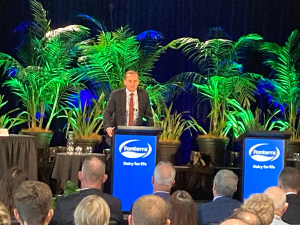
He says farms can be managed to sequester (i.e. fix) far more carbon than they emit and if all the pastoral land in New Zealand were to increase soil carbon by just 0.2% per year that would “more than offset the carbon emissions of the rest of the country”.
“Around the world scientists are pointing out that sequestration of atmospheric carbon into the soil, through means such as grazing livestock on permanent pastures and perennial crops, can be a natural and cost effective means of offsetting carbon emissions,” says Floyd.
“Research in Australia, the US, Europe and Africa has shown clearly that small changes in agricultural practice can have large effects on carbon capture.”
And work done in NZ backs this up, he says. Since 2008, Floyd has worked with a small group of pastoral farmers using his eCogent management practices designed to build soil carbon. He says annual standardised sampling to 1m deep and analyses by an accredited laboratory have shown steady increases in total soil carbon averaging around 5%.
He says this equates to 12 times the target set by the “4 per 1000 Initiative” – an action plan under the UN-sanctioned Lima-Paris Action Agenda, which aims to demonstrate that agriculture, and agricultural soils in particular, can play a crucial role where food security and climate change are concerned.
“This is highly significant,” says Floyd. “If just 25% of NZ dairy farmers were to do this the effect would be to offset all the emissions from the whole of the country.”
Results within the group of farmers varied with the season, the farm situation and with the skill and diligence of the farmer, but typical was an average annual increase of 5% in total soil carbon. This represents a gain in soil carbon of about 6 tonnes/ha. This converted to carbon credits at $25 per unit equates to an annual net income of about $150/ha – 10 - 20 times greater return than from forestry, says Floyd.
A paper written by Floyd outlines the process of carbon fixing in soils: “Soils are the world’s largest terrestrial carbon sink, containing far more carbon than the plant life on the surface. However, the carbon above and below ground is inextricably linked with plants using photosynthesis to extract CO2 from the atmosphere and convert it to carbohydrates that flow to the roots and are exchanged for minerals from soil microbes.
Floyd is seeking appropriate investment vehicles or Government shareholding that will “enable the eCOGENT business plan to be taken to the next level”.