DairyNZ chair wants cross-party deal
New DairyNZ chair Tracy Brown says bipartisan agreement among political parties on emissions pricing and freshwater regulations would greatly help farmers.
 increase font size
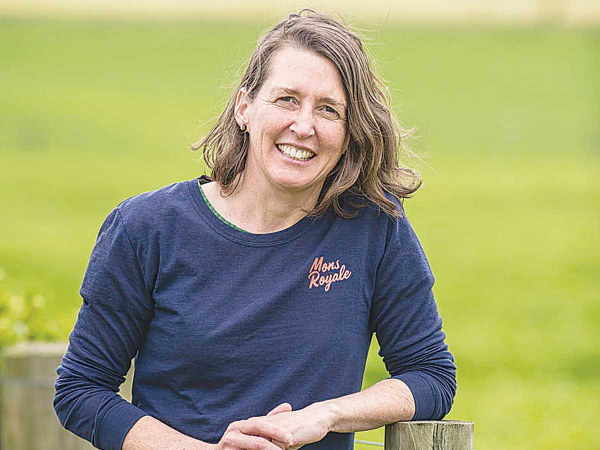 Kelly Forster
OPINION: Feedback is being sought from farmers, growers and others in the primary sector on options to price agricultural greenhouse gas emissions.
Two options have been released for discussion by He Waka Eke Noa - the Primary Sector Climate Action Partnership - which is a partnership between industry, Māori and government. The options that the partners will seek feedback on are a farm-level levy and a processor-level hybrid levy.
The other way to price emissions would be to include agricultural emissions in the NZ Emissions Trading Scheme (NZ ETS), described as the 'backstop' option in the consultation document. The Government has already legislated to include agricultural emissions in the NZ ETS but agreed to work in partnership with industry and Māori to design an alternative that would achieve better outcomes for New Zealand and the agricultural sector.
The two He Waka Eke Noa options are estimated to deliver emission reductions broadly aligned with current split-gas legislated targets in conjunction with existing policies and allowing for reductions from the waste sector, and if accompanied with the commercial availability of emissions mitigation tools such as methane inhibitors and low emissions livestock genetics. The legislated targets are for methane emissions to reduce by 10% below 2017 levels by 2030; and nitrous oxide and carbon dioxide to reduce to net zero by 2050.
He Waka Eke Noa partners DairyNZ and Beef+Lamb New Zealand will explain each option, answer questions and listen to farmer feedback as part of a nationwide roadshow. Other partners including Deer Industry New Zealand, Federated Farmers, the Foundation for Arable Research, Horticulture New Zealand and Te Aukaha (Federation of Māori Authorities), are also discussing the options with their farmers and growers.
More than 30 meetings and webinars are scheduled for the coming month. In light of the move by the country to the Covid-19 red traffic light setting, some changes have been made to the sector's engagement programme and partners will keep farmers informed of any further changes.
The Partnership has narrowed down pricing system options to two choices, and the backstop. Each option has its trade-offs, and this period of meetings, workshops and webinars is a chance for farmers and growers to learn about the choices and provide an opinion on their preference and feedback on how options may be improved.
The Partnership has also considered the possibility of starting with a processor-level hybrid levy and transitioning to a farm-level levy in future and will be discussing that with farmers over the coming month.
A key aspect of the two He Waka Eke Noa options is a "split-gas" approach that separates the short- and long-lived gases and applies different pricing mechanisms to each.
This recognises the different impacts of the main agricultural greenhouse gases: biogenic methane, nitrous oxide, and carbon dioxide.
The Consultation Document draws on extensive modelling and analysis of costs and impacts. The supporting technical reports are also available on the He Waka Eke Noa website: www.hewakaekenoa.nz/your-say
Details of events and webinars led by DairyNZ and Beef + Lamb New Zealand can be found on their websites DairyNZ and B+LNZ. Farmers and growers can provide feedback at the events or online. For further information contact This email address is being protected from spambots. You need JavaScript enabled to view it..
Kelly Forster is the programme director for He Waka Eke Noa.
New DairyNZ chair Tracy Brown says bipartisan agreement among political parties on emissions pricing and freshwater regulations would greatly help farmers.

First up to the podium at the recent Tractor and Machinery Association (TAMA) Conference in Wellington, Minster for Agriculture, Todd McClay, reflected on a difficult 12 months, but hinted at signs that things were turning the corner, saying “when ag does well, New Zealand does well”.
A horror story - that’s how Federated Farmers describes new research looking at forestry conversions’ impact on water quality.
OPINION: When Groundswell showed up in the 'advocacy hub' at Fieldays alongside the same groups that brought you He Waka Eke Noa, the Hound feared the ginger group had been brought into the woke fold and given the old rubber ring.
OPINION: Industry-good bodies have had a torrid time recently, with some facing backlash from farmers particularly over their stance on emissions pricing and He Waka Eke Noa.
New Zealand dairy farmers are set to be the first in the world to receive access to a new digital physical milk pricing tool that enables them to fix the price for their physical milk.
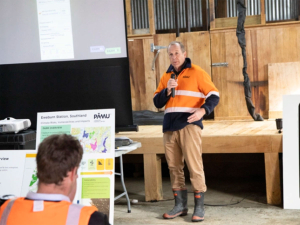
State farmer Pāmu is opening its farm gates this summer in an effort to give the rural sector the opportunity to see how large-scale, multi-system farming is delivering productivity and profitability across New Zealand.
A five-year study has found that the cost of reducing emissions without technology may be significant and unsustainable for Northland dairy farmers.
DairyNZ says Waikato farmers need certainty on Plan Change 1, but they say that certainty must be matched with practical, workable rules and a clear transition that doesn't get ahead of the new resource management system currently under review.
While the Government has moved quickly to make commercial hauliers' lot easier during the current fuel crisis, they appear to be stuck in the creep box when it comes to the agricultural industry.
Waikato farmers have been told that the Government’s new planning system legislation and the region’s Plan Change 1 (PC1) “won’t mesh together very well”.