Ford Vehicles Now Compatible With HVO Renewable Diesel
Continued fluctuations in fuel costs are putting pressure on many businesses, driving a significant spike in interest for electrified options like hybrids and alternative power sources.
 increase font size
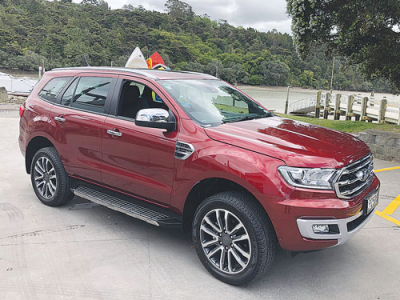 The revised Ford Everest Titanium may have replaced the 3.2L, five-cylinder single-turbo diesel with a 2.0L four-cylinder bi-turbo diesel but it still retains power and towing.
The modern trend to fewer cubic centimetres and more gear ratios continues as car manufacturers chase better fuel economy and lower emissions.
The revised Ford Everest Titanium does its bit by replacing the 3.2L, five-cylinder single-turbo diesel with a 2.0L four-cylinder bi-turbo diesel, and by replacing the six-speed automatic transmission with a 10-speed.
This efficient new drivetrain is the major update to the Everest, the rest being largely a visual refresh inside and out, changes to suspension tuning and some new active safety technology thrown in for good measure.
High-pressure fuel injection and low-friction design both feature in an engine that manages to get more from less: more power than the old 3.2L (157kW vs 143kW) and more torque (500Nm vs. 470Nm). Power delivery is similar to the old engine up to 3000rpm, at which point the 3.2L is done, but the 2.0L keeps making power up to 4000rpm. The small engine also makes max torque as low in the rev range as the 3.2L did. So it’s faster.
Towing capacity must be lower, surely? Not according to Ford: it says the new Everest can now tow an extra 100kg at 3100kg braked capacity.
And the payoff Ford was chasing -- better fuel economy at a claimed 7.1L/100km (combined cycle) -- is a decent improvement on 8.5L/100km.
The only real downside is the loss of tone: the old five-cylinder made a distinctive growl that the new engine can’t match. However, the new four-cylinder is more refined.
The new 10-speed can take some credit for the lower fuel consumption and for the better progress across country: with 10 ratios to choose from, the Everest was nearly always in the right gear for the road speed and conditions. Co-developed by Ford and General Motors, this transmission impressed with its smoothness and quick shifts.
Ford says it has fettled the damper tune, lowered spring rates and modified the front stabiliser bar to improve suspension performance. It’s hard to tell the difference behind the wheel, to be honest, but we’ve always found the Everest handled better than most SUVs with ute-based heritage. That remains the case and for such a high-rider it inspires confidence on the road, holding a line through corners and not bucking and wobbling like many in this category used to do.
Substantial off-road capability no longer requires comprised driveability on the road.
Like its Ranger stablemate, the electric steering is also well weighted, nicely accurate and, while a bit numb, still rates at or near the top of a class once known for vague tiller feel, to say the least.
Last but not least, the active safety technology has radar and sensors for Africa and now includes adaptive cruise control that matches the speed of traffic in front, blind-spot monitoring, rear cross traffic alert and a lane keeping system. The driver aid we appreciated the most though was the foward alert with collision mitigation, which prevented a nasty rear-ender. At least we know it works in the real world.
Continued fluctuations in fuel costs are putting pressure on many businesses, driving a significant spike in interest for electrified options like hybrids and alternative power sources.
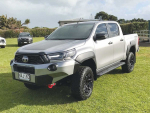
With Ford holding the reins of the ute market since about 2014, it was always going to be a case of when – not if – Toyota NZ would deliver a model to compete.
The latest addition to the long running Ford Ranger line-up, is the return of the FX4.
The Ford Ranger Raptor is not the truck you buy for heavy work; payload and towing capacity are significantly less than a standard Ranger or any other working-clothes ute. But that's not the point.
Having dominated the ute market for the last three years, Ford NZ says it will launch its 2019 Ranger in October.



LIC shareholders have elected a new North Island representative to the co-operative's Board, along with five representatives to its Shareholder Reference Group (SRG), following the company's Annual Meeting held in Invercargill.
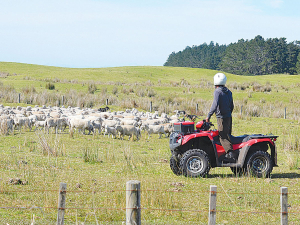
Farmers across parts of Southland and South Otago are continuing to deal with difficult conditions after a prolonged run of wet weather, with pressure building around feed supply, stock management, pasture damage, farm infrastructure and everyday workloads.
Federated Farmers says it welcomes Labour's commitment to reviewing the Sharemilking Agreements Act, calling on other major parties to do the same.
For Canterbury dairy farmers Sian Meijer and Rick Wobben, wearable technology has become one of their most valuable on-farm tools - helping manage 1850 cows across an expansive, high-performing dairy operation while improving efficiency, mating outcomes and day-to-day decision making.
Fonterra has unveiled its annual results for the 2026 financial year, posting $27 billion in revenue and close to $20 billion returned to New Zealand farmer owners and unit holders.
The first major update to the Dairy Cattle Code of Welfare in more than a decade has been released, marking what DairyNZ describes as an important step in ensuring animal welfare standards continue to evolve alongside scientific evidence and on-farm realities.