Scaled-back show meets targets
Organisers of the Christchurch A&P show say they are happy with this year’s event despite a rushed turnaround that left agricultural industry support thin on the ground.
 increase font size
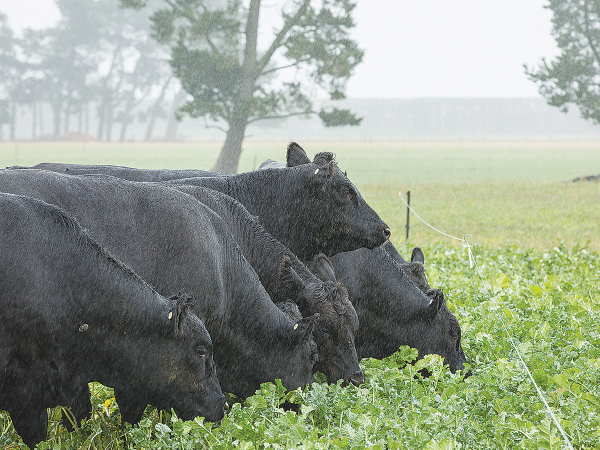 Steers grazing Ultrastrike treated Pallaton Raphno
Forage brassica crops provide an excellent source of energy and protein for grazing livestock at critical times of the year when the quantity and quality of pasture on offer is limiting livestock production.
A high yielding crop doesn’t just magically appear, good planning and management are absolutely critical to the outcome, particularly in the lead up to sowing and in the early stages of crop development.
One very important area for farmers to address is pest management. The first four to six weeks after sowing is a critical period in the life of a new crop, as seedlings emerge and develop their physical makeup. The longer a plant remains small the more at risk it is to attack from both insects and fungal disease. The loss of plants early can have a major impact on crop yield. The application of seed treatment agents onto seed helps mitigate against these risks, providing a low-cost early crop protection solution, helping ensure the crop is on its way to reaching its full genetic potential.
PGG Wrightson Seeds Ltd offers two different seed treatment options on brassica products supplied through its forage seed brands, PGG Wrightson Seeds and Agricom. The company has applied Ultrastrike and Gaucho to brassica seed for over 25 years, with both products market leaders in the seed treatment space. Of the two treatments, Ultrastrike is very much the premium product with its inclusion of systemic insecticide, two contact fungicides and molybdenum in the formulation, making it a more comprehensive offering than the insecticide- based Gaucho treatment.
The application of systemic insecticide in Ultrastrike provides protection against both biting and sucking insects, includ- TIM REDFERN ing Springtails, Aphids, Nysius and Argentine Stem Weevil. The active ingredient is released into the soil profile at germination. As the seedling develops it is taken up by the young plant roots and is translocated throughout the plant providing protection against the target insects for up to six weeks.
The fungicide activeingredients are also released into the soil profile at germination, creating a barrier around the root zone, blocking infection from the soilborne fungal pathogens; pythium, fusarium and rhizoctonia that cause ‘Damping Off’ disease in seedlings. The addition of molybdenum in the Ultrastrike treatment provides a startup supply of nutrient, that is available for fast uptake by the germinating seedling.
A field trial undertaken by PGG Wrightson Seeds Ltd in Canterbury highlighted how important seed treatment is in safeguarding seedlings through the plant establishment period. The scientific trial compared the plant establishment and subsequent crop yield of Ultrastrike treated kale seed and untreated kale seed.
An invasion of Springtails in the first three to four weeks after sowing cleaned out a large percentage of seedlings in the untreated plots, while the Ultrastrike treated plots established very well. When the crop yield was measured six months later, the untreated seed plots averaged 8100 kg DM/ha and the Ultrastrike treated plots averaged 15,900 kg DM/ha. The seed treatment provided a net financial return of over $1,500/ha.
Forage brassica crops play an important role in pastoral farming systems. Mitigating risks during early crop development is crucial to the success of these crops. Investing in seed treatment products such as Ultrastrike is an important step in the process.
Tim Redfern is sales manager at Branded Products for PGG Wrightson Seeds Ltd
Organisers of the Christchurch A&P show say they are happy with this year’s event despite a rushed turnaround that left agricultural industry support thin on the ground.
It was bringing in a new Canterbury A&P Association (CAPA) show board, more in tune with the CAPA general committee, that has ensured that Christchurch will have a show this year, says CAPA general committee president Bryce Murray.
Forage brassica crops provide an excellent source of energy and protein for grazing livestock at critical times of the year when the quantity and quality of pasture on offer is limiting livestock production.
A love of animal fleece is the driver for Anne Rogers who is this year’s President of the Canterbury A&P’s New Zealand Agricultural Show.
A renewed emphasis on how farm produce makes it from the paddock to the consumer will be a feature of the 2023 New Zealand Agricultural Show.


Farmers are being encouraged to rethink how they manage waste on farm with the launch of ruralwastesorted.co.nz, a new website bringing together practical tips, real farmer experiences and resources.

New Zealand Winegrowers (NZW) is celebrating the India-New Zealand Free Trade Agreement (FTA) coming into force today, bringing New Zealand wine improved access to one of the world’s fastest-growing economies.
New Zealand’s red meat sector has welcomed the India-New Zealand Free Trade Agreement taking effect, which removes India’s 33% tariff on New Zealand sheepmeat.
More than 95 per cent of New Zealand’s forestry and wood exports to India can now enter tariff free as the New Zealand-India Free Trade Agreement comes into force today.
Federated Farmers is backing Feilding High School’s call to keep Agriculture and Horticultural Science as a standalone subject in Year 11.
Food and fibre exports have returned a billion- dollar bonus to the country.