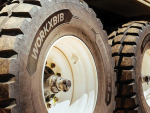
Those big black lumps at each corner of your tractor are the contact with the ground, and as such they ultimately convert the power delivered by the engine into traction.
So it's no surprise to understand that a little TLC can reap benefits in the long run.
Tyre wear can be caused by a number of issues, but the most likely causes are running at incorrect tyre pressures, operating in poor or arduous conditions that accelerate wear, or having incorrect alignment.
With tractor front tyres costing anywhere between $1000 and $3000 each, acting quickly to investigate uneven wear is good policy and can result in serious financial savings
Front tyre alignment, or indeed lack of, is probably one of the biggest causes or irregular tyre wear and, besides the capital cost of replacement, can result in poor operating efficiencies in terms of traction and fuel consumption.
The wear problem as a result of misalignment can also be masked by the enduring problem of New Zealand rural roads having no kerbs, resulting in the nearside wheels running on the broken edges and at strange operating angles.
First indications of poor set up can be irregular wear patterns on tyre treads, so after confirming that pressures are correct and sizes are compatible, particularly with four wheel drive units, the next area to take a look at is alignment.
This task is normally well within the realms of the average on-farm spanner man, but akin to the carpenter who measures twice and cuts once, the same rules apply. Take the time to measure accurately, and only make small adjustments. With that in mind acquire an accurate measuring device - a telescopic pole is best, but a good tape measure with a willing helper on the other end will suffice.
Alignment is ultimately a function of track width, whilst ensuring that both front wheels run parallel to one other, and also to the direction of travel. By measuring the distance between the front wheels at the 9 o'clock and the 3 o'clock position when viewed from the side, it is possible to ascertain whether the wheels are indeed 'pointing' straight ahead. Whilst straight ahead would be the ideal, the 'real world' tells us that a small amount of 'toe-out' is acceptable, as dynamic forces on the tyres during use, such as braking actually create a small amount of 'toe-in' and balance the static tractor settings.
So to carry out an alignment check firstly place the tractor on some level ground, and go and find the helper with the tape measure. Measure the distance between the wheel rims (not the tyre) across the front of the tractor at around the centre point of the wheel hub. Now move to the rear of the tyre and take same measurement, again parallel to the centre of the wheel hub.
Comparing the two measurements will give an indication of the alignment. The same measurement shows that the wheels are 'parallel', whilst a wider measurement at the front indicates 'toe-out' and a greater measurement at the rear shows 'toe-in'.
If required adjustment can be carried out by firstly by loosening the nut on the track control rod end, and after such using a soft hammer or punch to free the bolt from its taper. It's also good practice to discard the locking nut at this point and source a new item for replacement.
Now the track rod can be adjusted to the desired length to achieve the alignment required, whilst remembering that we are looking at figures in millimetres, so accuracy is vitally important.
A little trial and error may be required at this point to get the job right. Now reposition the wheel and re-insert the track rod into its location, using a smear of grease before reassembly, and tightening the new lock nut to pull everything into position.
At this point it is good practice to take a re-measure to ensure all is well. Now run the tractor forward around 20m and then do the same in reverse, and with all being well the job is done, so sit back and relax.
In closing remember that although it is tempting to squeeze every last penny from your tyres, badly worn rubber is a false economy. Not only can they be illegal and prone to blowouts, but they can end up costing you more in lost performance, particularly traction and handling. Rubber is perishable and can degrade, so you should consider replacing tyres that are over five years old, even if they have tread remaining.
Think carefully before considering used tyres. Modern tyres are a complex series of components and layers and although the tread may seem sound, you will not know the condition of the structure and carcass and whether it has been subject to abuse or damage. ω