Polaris unveils mid-size utility side-by-side
Polaris Off Road has unveiled the 2026 Ranger 500, an all-new mid-size utility side-by-side aimed at bringing the quality and reliability of the American brand into the value segment.
 increase font size
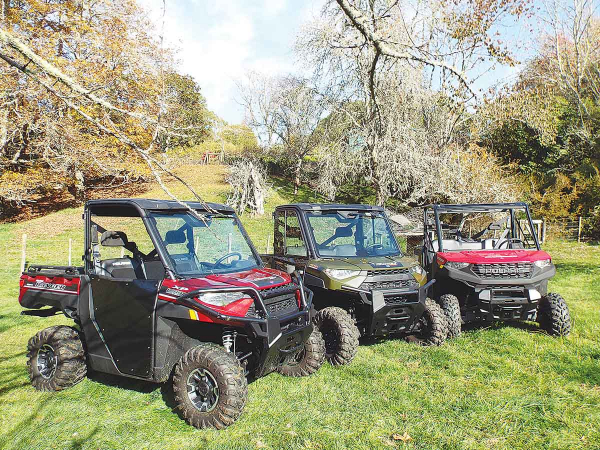 Polaris’s latest Ranger selection: the Ranger 1000 EPS, the Ranger 1000 HD-EPS and the Ranger Diesel HD-EPS.
On-farm transport was revolutionised with the arrival of quads, but really came of age with the side-by-side.
Polaris is a pioneer in the former and has carved a name for itself with the latter, particularly with its Ranger series. This model first saw the light around two decades ago, with a concept of making an ATV with seats for a driver and passenger seated side by side.
The first Ranger was a 6x6 – that over the years evolved into 4x4 – along the way picking up more power, better suspension, comfort and more seats.
Rural News recently got the chance to take a closer look at three of Polaris’s flagship models in the shape of Ranger 1000 EPS, the Ranger 1000 HD-EPS and the Ranger Diesel HD-EPS.
All three feature a robust chassis with double A-arm suspension layout at each corner. This offers excellent ground following characteristics, shock absorption and good ground clearance.
The Ranger 1000 EPS is fitted with a SOHC twin-cylinder, fuel injected engine delivering 61hp, that mates to the Polaris PRO-PVT transmission – a variable belt drive layout, with shaft final drives. In use, as the throttle speed is increased, take-up is smooth, while driveability – particularly at low speeds – is easy to control.
Drive selections are controlled via a large, dash-mounted shift lever with High/Low/Neutral/Reverse and Park options. Meanwhile 2WD, 4WD and Turf Mode choices are via a rocker switch, also in a central location.
Trialled in mixed conditions – with flat pasture, rugged bush and soft riverbanks in the mix – the vehicles handled everything with ease, with power delivery smooth, linear and easy to control.
Moving onto the bigger, petrol brother, the Ranger 1000 HD-EPS: While it carries over many of the mechanical functions from the more basic machine, it’s packed with useful extras to make it a standout in this very competitive sector.
For the operator, five inches more cabin room complemented by cushioned seats with adjustable slides, upped the ante in the comfort stakes. Six cup holders, two drinks holders and numerous stowage areas in the dashboard and under the flip-up passenger seats make the HD very practical to live with.
Power is provided by a DOHC 82hp fuel injected unit. This is never wanting in any task and is particularly suited to towing heavy loads, up to 1134kg in difficult terrain. Add in a load bed capacity of 454kg and you can see this vehicle is a workhorse.
A dash-mounted rocker switch offers three engine modes, with Power, Work and Standard on tap. Our test vehicle had the optional farm pack fitted. It includes a windscreen, surely a must-have in performance mode as nailing the throttle certainly makes your eyes water.
Third machine off the rank, the Diesel HD, will certainly find followers in the rural community for its frugal fuel use and removing the need to keep two fuels on farm. Although a little noisier than its petrol-powered cousins, this is no slouch, quickly building revs and topping out at 65km/h.
Power is provided by a 900cc, three-cylinder Kubota engine with mechanical injection that pushes out around 25hp.
A standout during our test drive was the low-down torque that meant shifting heavy loads and tackling inclines was a breeze, while undertaking descents with heavy loads behind was very controlled with good engine braking.
All three models showed excellent retardation on downhill sections, which could be accentuated by using the Active Descent Control Function. This is selected by a rocker switch that made things feel particularly safe. With disc brakes all round, stopping should never be a worry.
At higher speeds, when safe to do so, the driver is helped by a progressive suspension set-up, with difficult terrain handled with ease, aided by the ground clearance of around 28cm.
In summary, if you need to move three people safely around the farm, these three machines certainly warrant a closer look.
Polaris Off Road has unveiled the 2026 Ranger 500, an all-new mid-size utility side-by-side aimed at bringing the quality and reliability of the American brand into the value segment.
When you compare a RAM 1500 or Chevrolet Silverado to a Ford Ranger or a Toyota Hilux, you will understand why we need the designations truck and ute.
Think of a RAM 1500 or a Chevrolet Silverado and compare them to a Ranger or a Hilux: One is obviously a truck, and the other is a ute.
Off-road specialists Polaris has launched a new speedcontrol and geofencing kit, aimed at keeping operators and workplaces safer by allowing users to set maximum speed limits and limit speeds in geofenced areas.
Polaris Inc has unveiled plans to debut an all-new 2022 electric Ranger utility side-by-side in late 2021.



Almond hulls sourced from Australian orchards may have the potential to help New Zealand cows reduce emissions, boost milk yield and lower input costs.

Striking a balance between meeting the needs of industry to speed up approval time for products but on the other hand ensuring that risks are properly assessed.
Surprised, humbled and quite thrilled. That’s the reaction of James Allen, one of the founding partners and now chief executive of AgFirst, on being made a life member of the Institute of Rural Professionals.
It was billed as a chance for all the political parties to woo the rural vote, but question marks hang over just how effective this was.
Minister of Conservation Hon Tama Potaka has appointed Susan O'Regan as Chair of the Queen Elizabeth II National Trust (QEII) for a three-year term.
Red meat farmers are welcoming Labour’s plan to review the Emissions Trading Scheme and not to campaign on pricing agricultural emissions.