Stihl Launches BT140, Its First Battery-Powered Auger
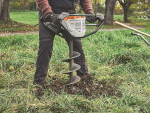
With battery tools becoming more widespread and more importantly, productive and reliable, it was only time before we saw augers or post-hole borers.
 increase font size
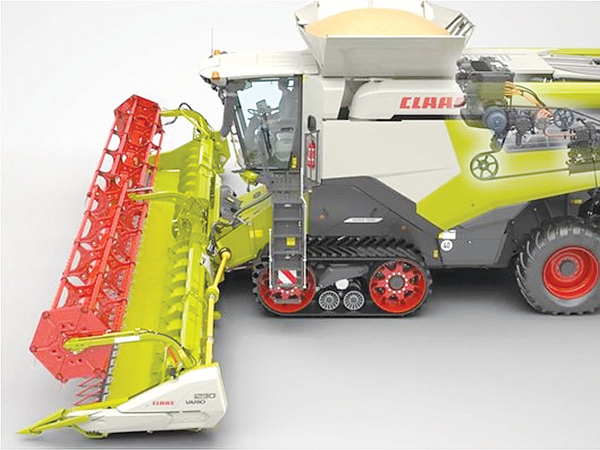 The semi-electric combine concept allows self-propelled machines to run on a less powerful engine.
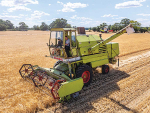
Harvesting and tractor specialist Claas has developed and field tested a combine harvester fitted with a part electric drive system.
In addition, working with fellow German company Liebherr, it has also developed a 100% electric telehandler.
The semi-electric combine, concept allows self-propelled machines that would normally be powered by a 626hp (460kw) powerplant to run on a less powerful 536hp (400kW) engine. A further benefit is that the smaller engine can operate at 1600rpm, instead of the normal 1800rpm.
This smaller engine and reduced speed is compensated for by a 40kW electric motor, that in more power-hungry situations, such as in high-yielding areas, travelling uphill or emptying the grain tank, provides the mechanical driveline with a short term electric power boost.
Replacing the conventional maximum output provided by the diesel block, the electrical support enables peak loads to be bridged, allowing the combine to consistently operate in the optimum performance range.
Flattening peak loads, the hybrid concept is claimed to reduce fuel consumption by up to 10%. In easier conditions where the full power of the diesel engine is not needed, a generator provides a regenerative function, converting excess power into electricity to be stored in the 3kWh battery.
The semi-electric system operates in the low, sub 60v range, so does not require the complex safety precautions associated with higher-voltage drives.
Claas says that this means maintenance can be carried out without any special training.
At this stage, the project is still at the early concept and testing stages, and it is not yet known if the system will make it to the production stage.
In other Claas news, the company is the latest to approve hydrogenated vegetable oil (HVO) for its products, although it is already widely marketed as a direct drop-in replacement for diesel fuel.
However, the company notes in its latest bulletin that while battery power may be suitable for lighter applications, an electrically powered Jaguar forage harvester would need to be twice the size and weight to provide the same power and range as the current diesel models, so for the foreseeable future, “traditional” fuels will continue to be important.
Keeping the diesel engine as the primary power source is seen as essential by the company. Dr Martin von Hoyningen-Huene, who heads the tractor division, notes that “there are no real alternatives to the combustion engine for high-performance agricultural machines in the foreseeable future”.
The company also states that gaseous fuels such as methane or hydrogen also have significant disadvantages in terms of their energy density and thus their energy storage requirements, while the infrastructure for supply and storage of these materials is still a long way away.
With battery tools becoming more widespread and more importantly, productive and reliable, it was only time before we saw augers or post-hole borers.
Austrian manufacturer Pottinger has released details of a new compact, linkage-mounted compact twin rotor rake, without a chassis, that is said to deliver impressive manoeuvrability.
The new Lemken Saphir XMR mechanical seed drill has been introduced as the successor to the proven Saphir 10m, with the manufacturer claiming new standards for precision, ease of use and area coverage.
Krone's XDisc 710 direct-cut header can now be used by John Deere and New Holland forage harvesters, as well as the Krone Big X it was originally designed for.
Fifty Eight years ago, on the 16th of August 1968, August Claas, the founder of the harvesting company and father of Helmut Claas, personally presented a Claas Senator combine harvester to Scottish farmer John Steven.

OPINION: David Seymour and James Meager's plan to make it easier for farmers and orchardists to operate drones can best be described a 'courageous' move.
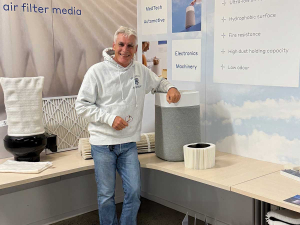
New Zealand wool is reaching new heights as air filtration companies move away from synthetic products to biodegradable alternatives.
Opuha Dam's ability to protect South Canterbury communities from major flooding has taken a significant step forward, with Opuha Water Limited (OWL) successfully commissioning a new outlet valve capable of releasing record volumes of water from the dam ahead of a weather event.
There's been widespread support from the primary sector for the Government's announcement on changes to freshwater farm plans that come under the Natural Environment Bill, which is now set to replace the existing RMA.
A partnership between state-owned enterprise Pāmu (Landcorp Farming Limited) and charity Meet the Need is putting more than quality New Zealand beef into food bank parcels this year.
The Opportunity Party has faced criticism during the election campaign that its policies are too urban-focused and offer little for rural communities.