How Bale Wrapping Transformed Forage Storage
Machinery and Products editor Mark Daniel takes a look at the history of bale wrapping.
 increase font size
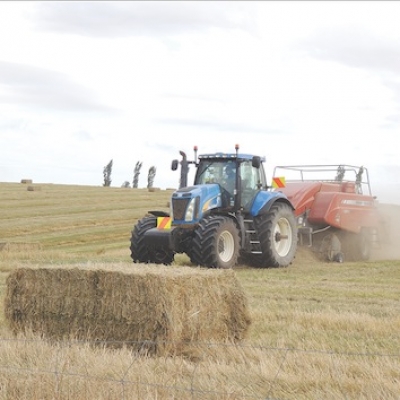 All steamed up and ready to bale.
An American lucerne moistening system could help New Zealand farmers and contractors deal with drought during hay baling.
Waiting around for natural dew is a thing of the past, the company says. Its DewPoint 6110 dew simulator for big square balers applies steam to dry hay at the baler. Hay may then be baled any time the crop is dry enough.
The machine, developed by grower Dave Staheli, is made by Staheli West Inc, Cedar City, Utah.
The DewPoint 6110 sits between the baler and tractor as part of a one-pass operation.
Steam is injected through manifolds into the hay as it is lifted from the windrow to the baler pickup and further as it passes through the feed chamber of the baler.
Four litres of water will produce about 6500L of steam, allowing an operator to add 19-26L of water to one tonne of hay.
When the injected steam contacts the dry crop material it condenses and bonds with other water molecules in the vicinity. Unlike when water is sprayed on hay to simulate dew, steam is absorbed instantly, retaining leaves and softening the hay.
The DewPoint 6110 makes higher quality, denser bales and increases baling capacity, says Dave Staheli. A grower baling 16-20ha/day with one baler can easily cover 80-100ha/day with a baler and a DewPoint machine, he claims.
Product consistency is said to be high. While in the cab, the operator can customise the steam application depending on how dry the hay is. Each manifold can be controlled separately.
“Moisture content is consistent in each bale, and the bales tend to be higher in quality because of higher leaf retention,” says Staheli.
The company seeks a New Zealand buyer or distributor.
Machinery and Products editor Mark Daniel takes a look at the history of bale wrapping.
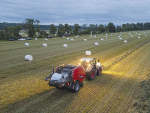
The Kverneland Group has announced several upgrades to its round baler ranges for 2025, much of it centred around automation, as well as the ability to wrap bales with film rather than net.
While baler-wrapper combinations have become the backbone of baled silage production, one machine stands out from the rest in the layout of the machine.
While round or large square bales have the dominant shares in the rural landscape, small square bales still play an important part, especially in the equine sector, but also where the large packages are not easily managed.
While the task of moving wrapped bales in New Zealand normally falls to trucks of flat bed trailers, in Europe, probably due to very strict secure load regulations, many trailer manufacturers are now offering more specialised trailers with hydraulically clamped side bars to keep load secure.
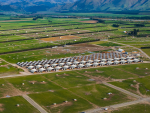

The Ministry for Primary Industries (MPI) says no new cases of H5 bird flu have been detected following a case found earlier this week.
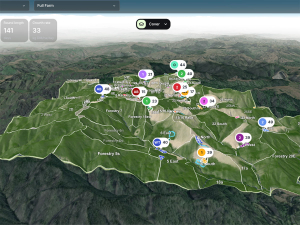
Two months after unveiling a major upgrade to its beef product, Halter says its farmers are on track for major production gains and additional grass growth.
New Zealanders are being urged to be alert following a confirmed positive case of H5 bird flu this week.
With a third of NZ dairy farmers still running outdated refrigerants, the country's largest farm refrigeration company says the opportunity for quick, meaningful emissions gains has never been clearer.
OPINION: Farmers are being put on notice by the Green Party.
As dairy farmers lock in plans for the upcoming mating season, a partnership between Fonterra and Silver Fern Farms has been formed with the aim of making it simpler to create additional value from calves not entering the replacement herd.