India FTA Removes 33% Tariff on NZ Sheepmeat
New Zealand’s red meat sector has welcomed the India-New Zealand Free Trade Agreement taking effect, which removes India’s 33% tariff on New Zealand sheepmeat.
 increase font size
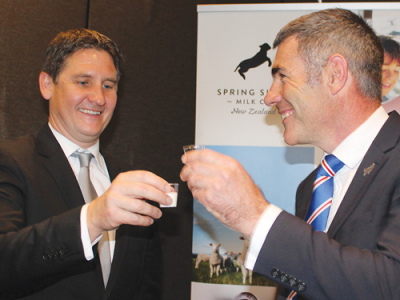 Spring Sheep chief Scottie Chapman and Primary Industries Minister Nathan Guy toast the new sheep milk PGP project.
The dairy sheep industry in New Zealand will be "turbo-charged" by a new $31.39 million Primary Growth Partnership (PGP), the Primary Industries Minister, Nathan Guy, claims.
Guy says the Sheep Horizons Three PGP programme will take the industry from revenues of about $10 million a year to $200m-$700m by 2030.
However, one MPI estimate puts that figure at $100m. The industry would only grow to about $33m by 2030 without the PGP programme aiming to deliver a market driven end-to-end value chain, according to this estimate.
MPI will put $12.56m (40%) into the new programme, and Spring Sheep Milk Co $18.83m – a total of $31.39m over its six year life.
Spring Sheep Milk Co is a 50/50 partnership between Landcorp and several NZ investors through SLC Ventures LP.
Spring Sheep Milk Co chief executive Scottie Chapman believes there is significant and growing demand for sheep milk, especially from Asia, where consumers like its nutritional value, flavour and digestibility.
"To achieve a sheep milk industry delivering domestic and export returns in the upper range of $700m, NZ will need up to 55 farms managed by farmers with specific sheep milking expertise," he says.
"The current farming model in NZ won't achieve this, which is why this joint investment by ourselves and MPI is so critical."
Spring Sheep Milk Co operates one farm with around 4000 East Friesian sheep, near Taupo.
MPI and Spring Sheep Milk Co are now negotiating a contract so the programme can formally begin.
MPI director-general Martyn Dunne says MPI wants to ensure the programme has wider benefits. It will look at genetics and other issues that enable the programme to be truly of national benefit. It has a programme for marketing and development, research and genetics.
"It also includes developing farming and environmental systems, which are topical these days, as is the social licence to be able to carry it out. They will be building the right capability and skills required for successful dairy sheep farming in NZ," Dunne added.
"I am certain we will develop a stream of people with specific skills in NZ in the sheep milk industry that will grow and benefit in the wider sense not only primary industries but dairy in its broader sense."
It also includes developing the land farming component, in which Landcorp will play a large role.
Chapman told the launch of the project in Auckland recently that they have a unique opportunity to strengthen NZ farming by getting it right in the market first. They will match the product to consumer demands and work backwards.
Sheep milk is worth at least $10 billion per annum globally and is growing at 10% globally.
Guy says NZ now produces about 160L/ewe/year and there is opportunity to grow by at least an extra 100L/ewe/year. However, the current NZ cost structure is higher than in other countries.
"There's opportunity to drive those costs down and increase the sale price by about $1/L."
Genetic development is an exciting opportunity – developing a strong multiplier NZ flock.
"The flock size and genetic pool in NZ is not great. If we are going to turbo-charge that we need to get the right size, get some AI, get some embryos in and grow the size of our nucleus."
Guy says the NZ industry needs to look at a prototype for housing, the best pasture species, work the animal husbandry model, develop onfarm trialling and produce a technical manual.
There will be open field days for NZ farmers to get involved and engaged.
The market insights will put the consumer at the centre plus developing high value products.
New Zealand’s red meat sector has welcomed the India-New Zealand Free Trade Agreement taking effect, which removes India’s 33% tariff on New Zealand sheepmeat.
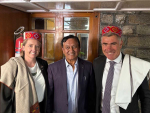
New Zealand's role is not to compete with Indian growers, according to NZ Apples and Pears.
The red meat sector is in great heart.
With lambing underway in many regions, Beef + Lamb New Zealand is encouraging farmers to put together a wellequipped lambing kit to help minimise lamb losses, particularly in bad weather.
Will a stronger, more coordinated voice help rebuild confidence and improve returns in the wool sector?


Federated Farmers has welcomed new rural policies released by ACT, saying they align closely with its own election priorities.
Rural Contractors NZ says proposed changes to land transport rules for agricultural vehicles are a welcome response by the Government to out of date regulations which have seen members hit with huge fines.
Alliance is calling for final applications for its 2027 Graduate Programme, with applications closing on Sunday 25 October.
Decades piloting planes has ensured vet and farmer David Hayes is focused on safety. So, after a serious accident while welding on farm, he is sharing his experience so others can learn from it.
Canterbury milk processor, Synlait Milk has confirmed Leon Fung as its chief executive officer.
OPINION: Making it easier to collect rainwater and use it to grow crops and livestock is a no brainer.