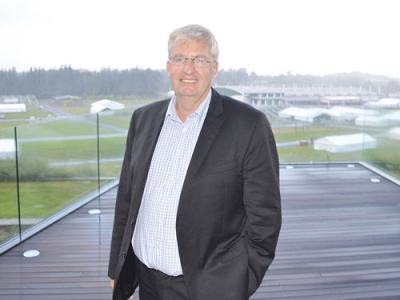
The New Zealand Agricultural Fieldays will have a greater focus on sustainability this year, says chief executive Peter Nation.
Visitors will be encouraged to use buses to travel to the venue, and more rubbish will be recycled as the four-day event rolls on.
Last year 131,000 people attended, the second-highest attendance ever.
“This year the dairy payout is up, beef prices are strong and we are gearing up for another good year,” Nation says.
To help ease transport issues, a ‘park and ride’ service will run from The Base at Te Rapa. People wanting to travel from Hamilton central to Mystery Creek can show their Fieldays ticket and get a free ride.
“Last year we did 4% of our gate by bus; we’re keen to increase this,” Nation told Rural News.
“We did a sustainability [analysis] last year and found we had saved 11 tonnes of carbon by using buses.
“We are having a greater focus on sustainability – recycling waste off our sites…. All rubbish gets sorted and we are looking to reduce the tonnage of waste going into the pit.”
Health and safety on site is also a priority.
Leading up to the Fieldays, 7000 contractors come onto the Mystery Creek property to prepare exhibitors’ sites – a record in NZ.
“We have people on the site to ensure the workers are wearing closed shoes and working safely; that is really important.”
This Fieldays will have 1587 sites –more than last year; all were booked before Christmas 2016.
To make the construction process easier, the Fieldays society had the whole site GPS mapped below and above ground; all site infrastructure is now on the GPS map.
Nation says he was told it was the biggest private civil GPS mapping done in NZ, with at least 10,500 points of interest.
Sonar was used to find all power, water and telephone lines underground. The site has a massive underground network of copper and fibre optic cables.
“Now we know with pinpoint accuracy where they go and where the joint points lie…. GPS mapping above ground has made all sites symmetrical; and site marking that once took weeks now takes only days.”
The Fieldays society has integrated the GPS maps with a new software system for event planning.
“Our boys sign off 1800 hole approvals for posts and poles; now we know accurately where the cables are; in the past it was in someone’s head.”