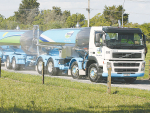
Fonterra Elections 2026: Voting Opens Tuesday 20 October
Fonterra shareholders can begin voting on Tuesday 20 October in the 2026 Board of Directors’ election, a Co-operative Council election in one Ward, and seven Annual Meeting resolutions.
 increase font size
 Jeremy Hill says Fonterra wants to see how Bovaer could work in NZ cows that are predominantly grass fed.
A new methane inhibitor showing promising results overseas is now being trialed in New Zealand with the backing of Fonterra.
The Bovaer feed additive, developed by global science company DSM, has reduced methane emissions from cows by over 30% in non-pasture-based farming systems in Europe.
Fonterra chief science & technology officer Jeremy Hill says the co-operative wants to validate how Bovaer could work in New Zealand cows that are predominantly grass fed.
“We also see this as an opportunity to further accelerate our global leadership in low-carbon dairy products to create more value for our New Zealand milk.
“Fonterra is working closely with DSM New Zealand to ensure that any innovation is well tested and can easily be distributed and used by our farmers.”
Global programme head for DSM Nutritional Products Mark van-Nieuwland told Rural News that DSM expects Bovaer to be commercially launched in NZ in the coming years.
It is under registration in other parts of the world.
“This is one reason Fonterra committed to this collaboration; to ensure New Zealand is in a leading position to roll out this technology for the farmer owners,” he says.
Two weeks ago, DSM announced between 27% and 40% methane reductions in a trial conducted with the Dutch dairy giant Friesland Campina, Wageningen Dairy Campus and three Dutch feedmills.
In December, a collaboration with Finnish dairy producer Valio was also announced.
“And in December, we reported on the largest and most extensive trial on methane inhibitors for beef...during the trial itself we saved nearly 1,500 tons of carbon dioxide emissions,” van-Nieuwland says.
While results from initial studies overseas have shown promise in non-pasture-based farms, more research is needed to understand the level of methane reduction that can be achieved on New Zealand farms.
Van-Nieuwland says testing is now underway with Fonterra to confirm this for New Zealand.
Asked about the cost of Bovaer, van-Nieuwland says successful methane mitigation solutions need to be cost-effective and easily adopted by farmers, and able to be counted against NZ’s greenhouse gas inventory.
“Commercial viability of the product will depend on the value to farmers of methane reduction and the ease of using the product compared to other potential mitigation strategies,” he explains.
“We are well aware of these considerations, and we believe we are on track to deliver against those.”
New Zealand dairy farms are acknowledged as having the lowest carbon footprint in the world among major milk producers. Recent analysis done by AgResearch, released last month, showed that New Zealand retains its outstanding position in low-emission dairy milk production, with an on-farm carbon footprint 46% less than the average of 18 countries studied.
Fonterra admits that biological emissions from cows are a major contributor to the country’s overall emissions.
Fonterra group director Farm Source Richard Allen says that finding a solution to the methane challenge requires more than just the hard graft farmers are putting in.
“We need to find a breakthrough in reducing emissions from cows and Bovaer could provide exactly that. This work with DSM is an exciting opportunity for the co-op.”
Nieuwland says DSM is proud to be in collaboration with Fonterra.
“Both companies have worked together for many years, and it’s a pleasure to extend this to the field of sustainability and climate change,” he says.
“With Fonterra, we have an important partner to potentially commercialise Bovaer in New Zealand and globally. We look forward to combining our expertise and passion.”
What is Bovaer?
According to DSM, Bovaer is a feed additive for cows and other cattle and ruminants - such as sheep and goats.
The production has been researched and developed over ten years by DSM. The company claims that just a quarter teaspoon of Bovaer per cow per day reduces enteric methane emission by approximately 30%.
DSM has filed the feed ingredient for commercial registration under the trade name Bovaer around the world. It is also working with partners from the dairy and beef value chain to prepare for the product's market introduction.
Fonterra shareholders can begin voting on Tuesday 20 October in the 2026 Board of Directors’ election, a Co-operative Council election in one Ward, and seven Annual Meeting resolutions.

Fonterra Co-operative Group chief financial officer Andrew Murray has resigned to take up a role outside the dairy giant.
Four candidates have been confirmed for two director positions on Fonterra’s board.
A record farmgate milk price and strong global demand is laying the foundation for continued growth of organic dairy farming in New Zealand.
Waikato milk processor Tatua has again declared a record milk payout to farmer shareholders, leaving other processors in the dust.


Federated Farmers has welcomed new rural policies released by ACT, saying they align closely with its own election priorities.

Rural Contractors NZ says proposed changes to land transport rules for agricultural vehicles are a welcome response by the Government to out of date regulations which have seen members hit with huge fines.
Alliance is calling for final applications for its 2027 Graduate Programme, with applications closing on Sunday 25 October.
Decades piloting planes has ensured vet and farmer David Hayes is focused on safety. So, after a serious accident while welding on farm, he is sharing his experience so others can learn from it.
Canterbury milk processor, Synlait Milk has confirmed Leon Fung as its chief executive officer.
OPINION: Making it easier to collect rainwater and use it to grow crops and livestock is a no brainer.