
Nasty surprise
The late expansion of Three Waters to Five by Minister Nanaia Mahuta seems to have caught her own Cabinet colleagues out, with even the Prime Minister's office taking a while to get its spin straight on this one.
 increase font size
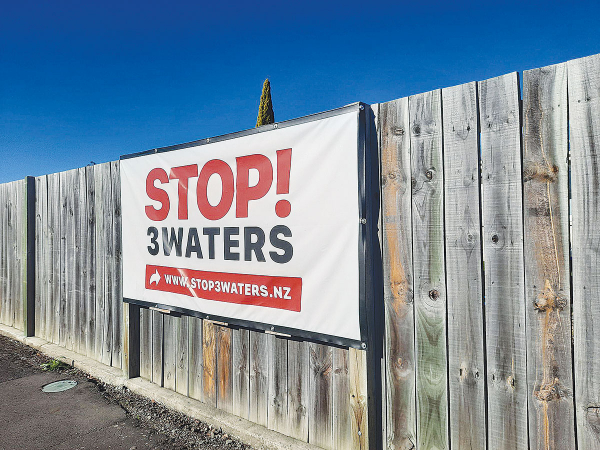 Both Manawatū District Council and Taupō District Council have spoken up in opposition to the Three Waters reforms at select committee this week.
Two district councils have spoken to the Finance and Expenditure Select Committee this week, expressing opposition and concerns regarding the controversial Three Waters Reform.
If passed, the Water Services Entities Bill would see the set up of new entities and transfer council management of water services to four water services entities. In return, councils would be made the sole shareholders in the entities, possessing one share per 50,000 people in their area.
A delegation from Manawatū District Council (MDC), led by Deputy Mayor Michael Ford, presented their opposition on Monday.
They expressed concerns around property rights and fair compensation for the investment made by residents, claiming there was a possibility that the transfer of Three Waters services into the proposed entities would stifle economic development.
“When approached by a development that involves an extension to three waters networks, MDC is able to negotiate directly with the developer to reach a mutually acceptable solution… The transfer of decision-making from local government to Entity C will remove MDC’s ability to work directly with customers to develop customised solutions,” Ford told the committee.
The delegation also questioned the proposed entities ability to cater for land use planning without local knowledge at a decision-making level and highlighted that decision-making around three waters assets needs to be made in conjunction with roading, district planning and economic development.
Speaking as the chair of Communities 4 Local Democracy (C4LD), Manawatū District Mayor Helen Worboys said the organisation had commissioned its own modelling which demonstrated the transition costs of setting up the new entities were wasteful.
“Castalia’s modelling for us shows that capital expenditure in the sector is actually financeable for the next 20 years, and beyond that with only the most modest of price increases. Accordingly, the four mega entity, “balance sheet separation” is simply not necessary. Other structural alternatives do exist and would effectively address the core problem,” she said.
Taupō District Council also spoke to Select Committee, with Mayor David Trewavas and councillor Kevin Taylor stating that the Council didn’t agree with the Government’s approach to the reforms.
“There is a need for our communities to have a greater voice on the management of three waters infrastructure, and our associated ability to shape the growth and wellbeing within our district,” Trewavas and Taylor said.
The select committee report on the Waters Services Entities Bill is due on 11 November and may include recommended amendments on the bill based on the submissions received. Government expects to push it through second and third readings to Royal Assent by the end of this year.
The late expansion of Three Waters to Five by Minister Nanaia Mahuta seems to have caught her own Cabinet colleagues out, with even the Prime Minister's office taking a while to get its spin straight on this one.
An assessment of Clutha District’s rural water supplies is currently underway.
Federated Farmers has called for the controversial Three Waters Reform to be stopped before the legislation bill reaches its second reading.
OPINION: Local Government NZ (LGNZ) has long advocated for privately owned rural water supplies to stay in community ownership - as part of the Three Waters Reform.
OPINION: A recent report on rural water schemes – commissioned by the Department of Internal Affairs (DIA) – will do little to quell users’ concerns about the Government’s contentious 3 Waters reforms.


New Zealand's citrus growers were challenged to build their future on the value embedded in their fruit rather than the volume they produce, at Citrus New Zealand's annual gathering in Gisborne on 17 September.

Leading John Deere technicians and apprentices from New Zealand and Australians were recognised at the recent sixth annual JD Technician of the Year Awards, held in Brisbane.
In Dacre, near Invercargill in New Zealand’s South Island, Bruce Dinnington is running a dairy operation unlike any other.
A free online platform aggregating governance vacancies across rural and regional New Zealand has been launched.
Environment Minister Nicola Grigg has announced details of a new rural plastics recycling scheme.
Agricultural drone operators say that a government decision to allow lower-risk drone work without certification won’t lower standards but drive innovation and efficiency.