
MIA Chief Executive Nick Beeby on Meat Industry Challenges and Cooperation
Meat Industry Association chief executive Nick Beeby says there’s now much closer cooperation between meat processing companies than there was many years ago.
 increase font size
 MIA’s Tim Ritchie says demand is increasing for high quality, safe blood products for pharmaceutical use.
The ability to send blood products and serum to China is “absolutely” important, says Tim Ritchie, Meat Industry Association (MIA) chief executive.
“The whole business model is about taking everything you can from an animal,” he told Rural News.
“Anything of any value is extracted and monetarised and that enables you to look after the farmer and hopefully make a profit. You’ve got the meat component and you’ve got the whole of the 'fifth quarter' -- the wool, pelt, skin, offal, edible and inedible, the rendering products.
“Blood in the old days would have gone down the rendering shoot and been made into blood and bone.
“Clearly there is an opportunity to not let it go down the shoot, catch it and use it in some higher value areas.”
His comments follow the announcement last month by Primary Industries Minister Nathan Guy that China has approved formal access for New Zealand bovine blood products into the Chinese market. Access has been approved by the General Administration of Quality Supervision, Inspection and Quarantine of the People's Republic of China (AQSIQ) for NZ premises to export bovine blood products such as bovine protein and serum to China.
Ritchie says demand is increasing for high quality safe blood products for pharmaceutical use.
“There is a real opportunity for NZ to capitalise on that. We had a relatively small trade in China which was suspended in 2015. The value of that trade was [in 2015] about $7 million for that year. Since then and now, with the regaining of access between the regulatory authorities here and over there, that will allow us to capitalise on increased demand which is clearly there for good quality product.
“The minister talked about potentially $50m value. I think we would fully support that based on information we have here from our members and those involved in that side of the business.”
And the value could be even more – up to $100m.
“It is something that will evolve and develop over the years ahead,” he says. “It will not evolve overnight. Having been suspended… it is a matter of our getting back in again and developing those relationships with the counter parties in that part of the world.
“It is a very positive move. If one can extract greater value out of a product than from it going down the shoot to be made into blood and bone meal, that is a net positive.
“In effect that will be the case because the people who will be collecting and selling it almost have to compete with the people doing the rendering so there almost has to be a better return. I am sure there will be value extracted and $50m is not an insignificant sum.”
Ritchie says it is in interests of people both sides of the farmgate to ensure one another's profit and viability.
“There is no future in an environment where one is capitalising at the expense of the other,” he says.
“For the long term both have to be in business and both have to be profitable by working together to try to make one and one equal three. If this is an opportunity to lift the value of a certain part of an animal, then ultimately that will find its way back to the farmer because it is a competitive industry.
“It is a good news story for farmers, processors and meat exporters. It is a bit like the other recent progress we have made in that part of the world.
“Different markets have different needs. That is the beauty of being an export focused industry: we are not reliant on one market to buy everything.
“That agreement between NZ and the Chinese regulatory agency not only allows the business to resume but provides certainty for commerce that allows it to go ahead and develop those relationships and further develop the business with more certainty.
“Business is all about management of risk and by getting these agreements in place that removes some risk from the equation and allows the companies to go ahead and invest further."
Ritchie says Department of Statistics data doesn’t differentiate between blood of human or animal origin, but last year blood export products to Europe were about $92m and to the US $36m.
“How much is animal or human we don’t know. But presumably a good part would be animal,” he says.
Meat Industry Association chief executive Nick Beeby says there’s now much closer cooperation between meat processing companies than there was many years ago.
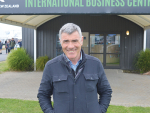
New Zealand’s red meat sector has welcomed the India-New Zealand Free Trade Agreement taking effect, which removes India’s 33% tariff on New Zealand sheepmeat.
The red meat sector is in great heart.
New Zealand's red meat and fifth-quarter exports reached $867 million in August, up 23% on the same month last year, as stronger returns lifted earnings across all major markets.
Meat Industry Association data, released alongside the Red Meat Sector conference in Wellington, shows export value climbing across the US, China, UK and Canada.


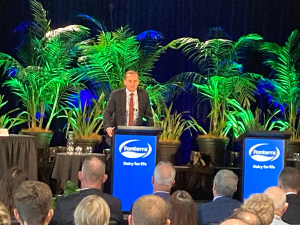
Fonterra’s 2026 financial year was a year of delivery, with record volumes of milk collected, processed and shipped by the co-op.
OPINION: The Government's decision to reinstate agriculture and horticultural science as a standalone subject from Year 11 is the right one.
Dairy farmers, still holding onto their Fonterra shares despite switching milk supply elsewhere or exiting the industry, now face a stricter share sell-down requirement.
Hamilton-based agritech company Aimer Farming has completed a $3 million capital raise to support its next stage of growth, including a beef farming product due to launch in 2027.
When dairy manager Miriam Lauridsen learned the farm, she was joining held weekly health and safety meetings, she initially thought that was “a bit over the top”. Experiencing that culture changed her mind.
Nominations are open for the 2027 Fonterra Dairy Woman of the Year Award.