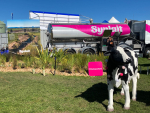
What Would Synlait Be Worth to Fonterra or a2 Milk?
Speculation of a possible joint move by Fonterra and a2 Milk to buy Synlait raises a much bigger strategic question, says agribusiness expert Dr Nic Lees.
 increase font size
 Special agricultural trade envoy Hamish Marr
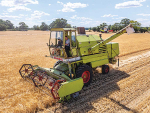
Profitability issues facing arable farmers are the same across the world, says New Zealand's special agricultural trade envoy Hamish Marr.
The arable industry is facing "the perfect storm" and New Zealand is not alone, Marr told the Foundation for Arable Research's "Show me the money" conference at Lincoln University recently.
New Zealand is a major player in herbage seed production which is in global oversupply. Growers also rely on a free market price for grain which is linked to the global price.
Marr, a Methven mixed arable farmer, says the problem with arable is the gross margin.
"There is simply not enough money being generated."
A cost of production spreadsheet commissioned by FAR, based on a Canterbury irrigated farm, showed a gross margin of $983 a hectare for feed wheat and $951/ha for ryegrass seed for the 2025 harvest. For the ryegrass crop, the gross margin essentially represents only the value of the straw, he says.
"This isn't anyone's fault as we are dealing with the international price, but the challenge is how to turn this around."
Arable exports are worth $340 million, with another $1 billion in arable production underpinning the domestic pastoral sector.
Yield has the biggest positive influence on cost of production and this needs to increase to produce more on less land.
"So instead of growing five crops I will have to grow 10. Diversification is nothing new for arable farmers, but we need to diversify, be agile and look at integrated systems. Some of us will look at horticulture, some dairy and some may even go back to ewes and lambs."
Marr also questioned who had oversight for the arable sector. This was not FAR, whose mandate is research and development, or Federated Farmers, which advocates for all farmers. A formal agreement needs to be reached on who is responsible for different roles. No one is advocating for arable in Wellington to governmnent and others, he says.
"Onions NZ have a $200 million export market and have several people in Wellington and they brief me before trade delegations. No one rings me from arable."
A vacuum in information gathering also exists in the arable sector.
"Whoever brings arable together, needs to bring the data and technology together and to link this with other sectors," Marr says.
In her last speech as FAR chief executive before stepping down, Alison Stewart said it is widely recognised that arable crop production in New Zealand is more expensive than in many overseas countries because of higher land and labour prices and greater input costs.
Over the years, New Zealand arable growers have been able to stay competitive because of their ability to generate much higher yields, averaging 12 tonne/ha for milling wheat compared to 4t/ha overseas.
"Unfortunately, there comes a time when further yield optimisation is either no longer possible or no longer acceptable under resource use limits. Arable growers are now facing this situation."
FAR's conference looked at ways of maximising returns through the application of proven research and technology. This included only applying an economic optimum rate of nitrogen fertiliser while utilising soil nitrogen supply, and options for reducing agrichemical inputs without compromising crop production and profitability.
Speculation of a possible joint move by Fonterra and a2 Milk to buy Synlait raises a much bigger strategic question, says agribusiness expert Dr Nic Lees.
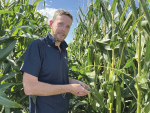
Four years since it was first detected in New Zealand, researchers and growers now know much more about management of maize pest fall armyworm (FAW).
Lynnette Hudson's 30-year obsession with Pinot Noir was sparked working vintage in Burgundy, seeing how subtle changes in terroir were expressed in the glass. It was, she says, "an elightening moment in every way".
A four year trial has reaffirmed that mixing plantain into dairy pastures can help reduce nitrogen losses to freshwater while maintaining milk production and profitability, say researchers.
Twenty five secondary school students from around New Zealand recently completed a three day residential programme designed to explore career opportunities across the food and fibre production supply chain.


An Auckland gelato shop and an established New Zealand ice cream maker have both been named Supreme Champions at the NZ Ice Cream & Gelato Awards 2026.

As the cost-of-living crisis continues to put pressure on household grocery budgets, new figures show pork remains one of the most affordable fresh meat options for New Zealand families.
OPINION: In politics, credibility is and should be big. It must surely rank higher than charisma, which is quite trite and superficial. Yet, voters nowadays are often wooed and influenced by how someone looks or talks at a superficial level. TV plays a huge role in this.
Farmers can spend less time on paperwork, thanks to a new data sharing agreement between DairyNZ’s DairyBase and LIC’s MINDA software.
Kaikōura families affected by July's severe storm have found a practical solution to a problem that's kept some children away from regular schooling for weeks: a washed-out section of Inland Kaikōura Road, which has stopped the local school bus from running its usual route.
Rural New Zealand is welcoming the Government’s recent package of rural healthcare initiatives.