Wilding pines are the wrong tree in the wrong place, and they need to go, says Biosecurity Minister Andrew Hoggard.
He made the comment when announcing that the Government will spend $109 million, of which $79m is new money, over the next three years, to tackle the wilding pine problem.
He says that $30 million of the funding will come from the international visitor levy.
Wilding Pines Threatening Millions Of Hectares
Wilding pines affect about two million hectares of land; 85% of that is on Crown land and in particular the Department of Conservation (DoC) estate and it's the pine seeds from this land that grow on farmable pasture.
Hoggard says the seeds can blow up to 30km away, so there are wilding pines popping up here, there and everywhere (Wilding pines are self-seeded from various species of exotic conifer and continue to grow where they are not wanted).
Water Supplies And Hydro Generation At Risk
Beside invading pastures and destroying NZ's unique landscapes, these unwanted Christmas trees have other insidious effects, says Hoggard.
"Probably the biggest problem is that the pines suck up huge amounts of water in the back country - water that's fed into our hydro dams and the big water systems," he told Rural News.
"If wilding pines are not controlled, it's estimated that over time it will cost $2 billion or more to irrigate land to grow high value crops and open up more intensive farming systems. At the same time, the water lost to wailding pines will mean less water in the hydro dams and that could lead to higher electricity costs," he says.
Challenging Terrain Makes Control Difficult
Hoggard says if unchecked, wilding pines will have a significant economic effect on the country.
Hoggard admits the task of dealing to the wilding pines is not easy.
In his words, it's not like hitching the boom sprayer on the back of the tractor and spraying out the cali' thistles on a flat paddock.
The terrain where the pines are growing is steep, often inaccessible and the nature of the infestations can vary.
"If it's a thick infestation where you can barely walk through these pines, you'll get in a helicopter with a boom spray, or if they are scattered all over the show and its pretty rough terrain, you might get in a helicopter with a device that can cut them down.
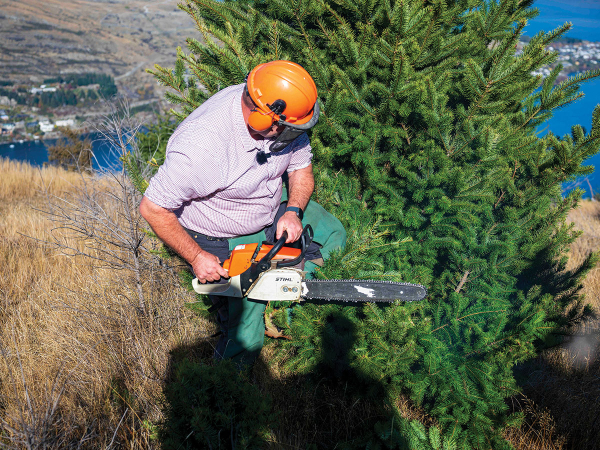
"Drones could be used for spraying and in reasonable terrain where there are small seedlings, a chainsaw or loppers could be used. Finally, you might just clear a path around the edge of the trees and put a match to it," he says.
Hoggard says it's a mix of what is the most appropriate tool to use to deal with the wilding pines.
Focus On Source
The overall task of controlling wilding pines is in the hands of a national working group responsible for the overall strategy.
At a local level there are groups, similar to catchment groups, which include farmers and regional council, who determine what’s to be done in their area and they get their funds from the national organisation. Most of the actual work is contracted out.
This programme is not just about clearing wilding pines from farmland, says Andrew Hoggard. Much of the work will focus on Crown land where the pines grow and from where the seeds spread to nearby farms.
He points to one area that will get special attention: Branch Leatham in northern Marlborough. This is a former sheep station, long gone, and now in Crown ownership and covered in the pesky pines which seed and infect the nearby iconic Molesworth station.
This latest plan, says Hoggard, mirrors that of the TB eradication programme which saw the number of TB infected herds drop from 1700 to about 15 following a concerted and well-funded programme to deal with the problem.
“This new programme with the promise of long-term funding will go a long way to dealing with the problem. In the past this hasn’t happened,” he says.
Feds Back Initiative
Federated Farmers describe the new initiative as a breakthrough and says the programme for the eradication of wilding pines has been severely underfunded. They add that it is an intergenerational issue.
While pleased with the new programme, president Wayne Langford says he believes that $50 million a year is needed over the next decade to halt the spread of the pines.
Langford says now that government has stepped up, it will be a case of action from landowners and land managers.
“We already have many farmers doing a lot of work out there, but now we need other landowners, councils, and the private sector to do the same so we can maximise the impact of this funding,” he says.
Feds pest spokesperson Richard Dawkins says the investment is a huge win, not just for farmers, but for all New Zealanders. He says wilding pines are an ecological disaster threatening farms, exports, biodiversity, tourism and water resources across NZ.
“Most Kiwis don’t see the problem day-to-day, but these invasive trees are spreading across some of our most iconic landscapes at an alarming rate. This funding boost will make a real difference,” he says.