NZW Fellows: Sir Sam Neill Remembered for His Deep Love of New Zealand Wine
Sir Sam Neill made an extraordinary mark on the world, and on the world of New Zealand wine.
 increase font size
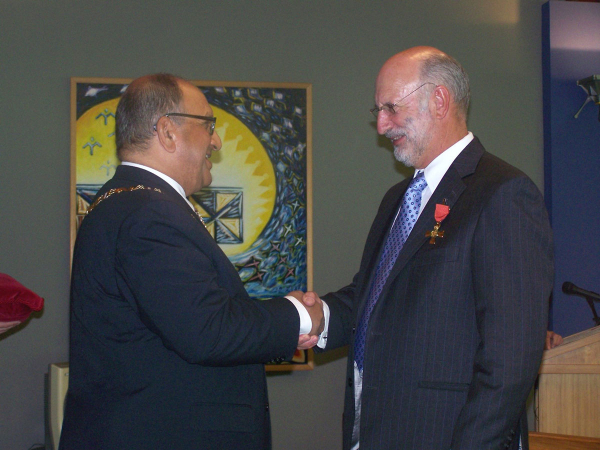 Colin Harvey receiving his Officer of the New Zealand Order of Merit Insignia from then Governor General Sir Anand Satyanand in April 2008.
Colin Harvey, one of the NZ agri-sector’s foremost innovators and contributors, died in a drowning accident in late January.
Harvey will be remembered for making major contributions to the New Zealand agricultural industry in a number of areas.
He is probably best known for starting animal health company Ancare in 1985. The company grew to be a leader in the animal health industry, supplying animal healthcare products to the New Zealand market and internationally – gaining significant market share across several animal health categories in the face of strong competition.
In 2007, the trading assets of Ancare were sold to multi-national animal health company Merial and in 2014 it also acquired the remaining R&D assets of Ancare, which had been operated by Harvey as a separate development company.
Hailing from a family of dairy farmers in Taranaki, Harvey graduated with a Bachelor of Agricultural Science from Massey University and a Bachelor of Commerce from the University of Auckland. After leaving university, he worked in a range of roles and companies in the animal health sector –including marketing and general management with Coopers Wellcome in New Zealand and Australia.
In an interview with the NZ Herald in 2002, Harvey described his first day on the job as ‘like being in a cage’.
“I arrived that morning through a mass of Auckland traffic to meet my boss, John Wright, and the rest of the Pfizer company – about six dark-suited people involved in pharmaceutical marketing. I was part of a new veterinary division,” he explained.
Harvey admitted that he had no idea of the world of commerce or business.
“I was raised on a Taranaki dairy farm, I had led a boozy, rough and tumble life through university doing various farming-type jobs including as an artificial breeding technician. This, with an agricultural science degree, was supposed to qualify me to put these trials together.”
Harvey told the Herald that most of his peers at Massey were horrified that he had ‘sold my soul’ to take this job. He said that at the time, the common start for agricultural science graduates was to join the Ministry of Agriculture and Fisheries as an adviser or in field research.
However, Harvey’s commercial-nous was evident even then: “I joined Pfizer because it offered a salary of £3600 – when the starting salary at MAF was £2400.”
After working for a number of animal health companies, Harvey set up Ancare in 1985 – with a mortgage on his house and $15,000 in holiday pay.
His contributions to the agriculture and animal welfare sectors were recognised in 2008, when he was made an Officer of the New Zealand Order of Merit and in 2009 inducted into the North Shore Enterprise Hall of Fame.
In his speech, when inducted in the North Shore Enterprise Hall of Fame Harvey said the most rewarding aspect of his career was that: “mates from veterinary school at Massey University became my customers.”
In 1988, Harvey founded the Animal Remedy and Plant Protectant Association and – through chairing this – contributed to the formation of the new Hazardous Substances Act and the Agricultural Compounds and Veterinary Medicines Act.
After selling Ancare, Harvey kept close links to the agri-sector buying and farming Lake McKay Station in Wanaka (11,000 su), funding and chairing Country TV, as well as being a council member of Massey University.
He also remained an active investor in a number of technology investments and the chair of the Hobbiton theme set.
Sir Sam Neill made an extraordinary mark on the world, and on the world of New Zealand wine.

Tributes are pouring in from across the political divide for former Prime Minister Jim Bolger who passed away, aged 90.
Pukekohe vegetable growers farewelled 101-year-old Alan Wilcox in late July, celebrating his many achievements and reflecting the widespread respect in which he was held.
OPINION: When news broke that Sir Bob Jones had died at age 85, the nightly news bulletins all led with the old footage of Sir Bob punching a reporter - the implication being that it was a terrible event in our history.
Tributes have flowed in from around the country for mid-Canterbury farming leader Chris Allen who died in a tragic accident on his farm near Ashburton.



Ravensdown shareholders have elected Jane Montgomery and Kate Acland to the Ravensdown Board for three-year terms, following a closely contested director election.

Federated Farmers says new legislation replacing the Resource Management Act will cut red tape, unlock investment and help grow New Zealand's export-led economy, after the Planning Bill and Natural Environment Bill passed their third reading in Parliament yesterday.
Leading figures from the major political parties will be questioned on their primary sector policies at the Rural Issues Debate at Mystery Creek Events Centre, Hamilton, on 30 September.
OPINION: Have a plan in place now!
Beef + Lamb New Zealand (B+LNZ) says it welcomes the passage of the Natural Environment Bill and Planning Bill, calling the bills a positive step for sheep and beef farmers.
A spate of southerly winds bringing cold temperatures has presented challenges for Taranaki dairy farmers.