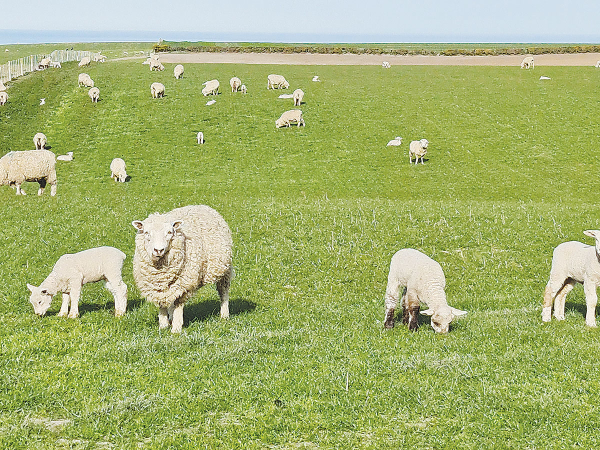
The targeted management of triplet-bearing ewes in the four to six weeks before lambing can significantly increase the kilograms of lamb weaned and therefore dollars produced per ewe.
By feeding tripletbearing ewes to increase their intake of high-quality pasture in the four to six weeks before lambing, both lamb survival and lamb growth rates will be enhanced.
The pasture needs to be of high quality and at least 1200kg DM/ha (or 4cm high). This height allows the ewe to maximise the quantity of grass she harvests in every mouthful.
Rumen size does not differ between twin and triplet-bearing ewes. So, from a nutritional point of view, the two groups do not necessarily need to be separated. However, if one group is to be given preferential treatment, it should be the triplet-bearing ewes.
The ewes should be at a Body Condition Score of 3 (minimum) and the ewes should be 20kg heavier at lambing than at mating. This takes into account lambs, membranes and fluid. If triplet- bearing ewes are not 20kg heavier, then they will have lost body condition and lamb survival may be compromised.
If pasture is limited, then ewes carrying triplets should be prioritised for supplementary feeding with a high energy supplement such as peas, grain or sheep nuts. Average or low-quality silage or hay is not recommended because of its high bulk.
Farm trials showed there was no advantage to feeding a high protein supplement to tripletbearing ewes that were well fed on pasture. This is because it is usually energy rather than protein that is the limiting factor.
Tightening feed in late pregnancy does not reduce birth difficulties or bearings. It does, however, increase the risk of metabolic diseases such as Sleepy Sickness.
Underfeeding at this critical time can result in smaller, weaker lambs, poor mothering behaviour and reduced colostrum and milk production.
Avoid set-stocking too early. Set-stocking too early can mean all the pasture is eaten before lambing is finished. This will impact on milk production and pre-weaning growth rates.
If pasture is slow to come away in spring, consider supplementary feeding single ewes and giving the best pasture to the ewes with triplets.
Triplet-bearing ewes should be lightly stocked at less than 10 ewes/ha to help minimize disturbance at lambing.
The longer the ewe stays on the birth site, the stronger the bond between the ewe and her lambs. Alternatively, the triplet-bearing ewes can be spread evenly across the twin-bearing mobs. This can reduce the number of lambs in a given area, with the aim of reducing mismothering.
Shelter is particularly important for triplet lambs. Their body temperature is lower than twin lambs and they lose heat faster because they are smaller.
Maximise Pre-Weaning Growth Rates
Ewes rearing three lambs can have difficulty eating enough for themselves and three lambs.
To maximise the ewe’s intake and drive lactation, graze pastures no lower than 4cm or feed high quality forages such as lucerne and clover/herb mixes.
Source Beef+Lamb NZ