
LIC: Faster Bull Team Change Reflects Genetic Progress
In the past, a bull could sit comfortably in a breeding team for several years with little change, but today, that’s no longer the case.
 increase font size
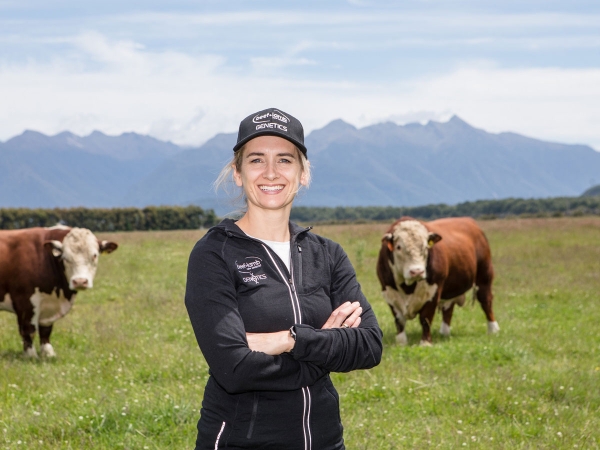 INZB programme manager Gemma Jenkins.
More bull breeders are using genetic tools according to the latest research.
One in five commercial beef farmers are now using artificial insemination and more than three quarters of commercial farmers (77%) are buying bulls from breeders that use genetic tools such as estimated breeding values, breeding indexes, artificial insemination, genomics and/or embryo transfer.
The research was done for the Beef + Lamb New Zealand-funded Informing New Zealand Beef programme (INZB).
Gemma Jenkins, programme manager at INZB, says it is encouraging to see the overall increase in awareness of INZB tools, a rise in the understanding of the numbers and science behind beef genetics and the ability to apply the genetic processes on farm, and a continued belief in the use of genetics.
“This is the third year we have undertaken the survey and it’s evident that the industry is making progress. Breeders are confidently using genetic tools,” she says.
Ninety nine per cent of breeders surveyed are using genetic tools and the usage has grown significantly across nearly all types of genetic tools compared to 2021 and 2022.
Ninety per cent of trusted professionals and breeders are also encouraging farmers to use superior genetics. There has also been a significant increase in the number of farmers using artificial insemination, up from 11% to 20% since 2021.
“This is interesting and we’re going to explore more about why we have seen this change,” says Jenkins.
“A significant majority of the farmers responding to the survey also want to be able to compare bulls across breeds.”
The seven-year INZB partnership, supported by B+LNZ, the Ministry for Primary Industries (MPI) and the New Zealand Meat Board, aims to boost the sector’s profits by $460m over the next 25 years.
It is focused on increasing the uptake of use of genetics in the beef industry. The four main components are building a genetic evaluation and data infrastructure, progeny test herds, developing breeding objectives and indexes and developing new data sources.
The industry survey tracks changes in industry attitudes and behaviours towards beef genetics over time. An analysis of the findings and suggestions from respondents will help inform the programme.
There were 336 responses to the survey including 187 commercial farmers, 112 bull breeders and 37 influencers.
In the past, a bull could sit comfortably in a breeding team for several years with little change, but today, that’s no longer the case.
Scanning is a great time to start identifying and managing groups of ewes based on feeding priorities. Wormwise's Mary Bowron discusses some of the possible reasons ewes lose condition in early winter - and it's not necessarily internal parasites.
Healthy, well-grown calves are the building blocks of any future dairy herd. Giving them the best start to life is crucial, and the primary strategy to reduce the burden of disease caused by rotavirus infection is vaccination.
Beef + Lamb New Zealand is reminding farmers with lucerne stands to graze them hard over the next few weeks in preparation for a winter weed control programme.
Genetics plays a central role in helping farmers lift per-cow productivity over time.
New Zealand dairy farmers are set to be the first in the world to receive access to a new digital physical milk pricing tool that enables them to fix the price for their physical milk.
State farmer Pāmu is opening its farm gates this summer in an effort to give the rural sector the opportunity to see how large-scale, multi-system farming is delivering productivity and profitability across New Zealand.
A five-year study has found that the cost of reducing emissions without technology may be significant and unsustainable for Northland dairy farmers.
DairyNZ says Waikato farmers need certainty on Plan Change 1, but they say that certainty must be matched with practical, workable rules and a clear transition that doesn't get ahead of the new resource management system currently under review.
While the Government has moved quickly to make commercial hauliers' lot easier during the current fuel crisis, they appear to be stuck in the creep box when it comes to the agricultural industry.
Waikato farmers have been told that the Government’s new planning system legislation and the region’s Plan Change 1 (PC1) “won’t mesh together very well”.