37 farmers from across the Rangitīkei and Manawatū regions recently spent a day-and-a-half learning new business management and planning skills at Rabobank’s latest AgPathways Programmes in Whanganui.
First run in 2016, the AgPathways Programme was developed by Rabobank’s Lower South Island Client Council with the aim of expanding young farmers skills and contacts to advance their careers in the agricultural sector.
The programme has taken place annually in Otago/Southland across the last decade with the tenth Lower South Island edition taking place in Gore earlier this year.
With the Lower South Island events proving a hit with local farmers, Rabobank’s Lower North Island Client Council made the decision to replicate the programme in 2023 and, across recent years, events have taken place in Manawatū (2023), the East Coast (2024) and South Taranaki (2025).
The latest AgPathways took place on Thursday 25 and Friday 26 June and was the first to be held in Whanganui.
Rabobank Lower North Island Client Council chair Mark Chrystall opened the Whanganui AgPathways and said the free programme provides participants with a range of tools to help them move forward with their agricultural careers.
“Over the course of a day and a half, the 37 attendees heard from a range of speakers who covered diverse topics such as personality profiling, financial skills, succession, sustainability, planning, strategy and leadership,” he said.
“They also heard from several local farmers who shared their personal farming journeys and how they’ve developed their businesses over time.”
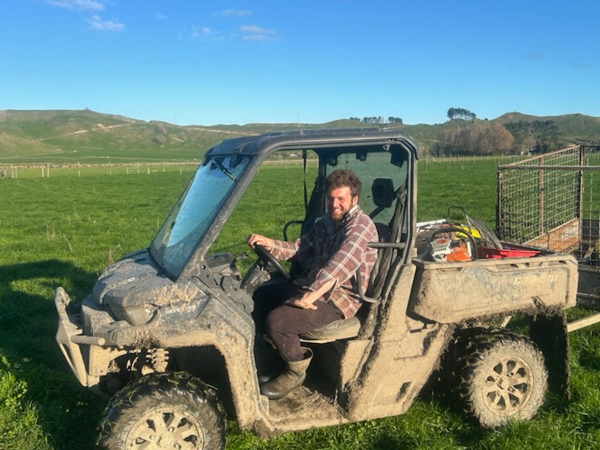
Programme attendee, Connor O’Leary, said plenty of the sessions across the day and a half had resonated with him.
“I really enjoyed the presentation on personality testing as it was the first time I’ve ever really dug into that sort of thing,” he said.
“The session identifies four different personality types and really provided me with a better understanding of how other people respond to instructions, and how they relate to other people and why.
“And following the programme, I’ve been able to identify the personaility types of some of the people I interact with regularly.”
O’Leary, who works on his parents 1650 cow dairy farm in Whangaehu, said he also found the session on farm succession and the farmer panel hugely valuable.
“I’ve got four brothers who are keen to come home to the farm, so it was quite nice to get my head around what might be coming up in the future, and to get some information on succession and how best to approach the situation,” he said.
“But I think the farmer panel was the best part of the whole event.”
“It was really cool to hear from a few different farmers, including one who was in an equity partnership, as they’d all started out with not much and gone on to achieve something.”
Another of the AgPathways attendees, Will Lilburn, said he’d also really enjoyed the programme.
“I thought the personaility testing session was more than interesting, and could be a really valuable exercise to do with staff,” he said.
Lilburn, who is a fifth-generation farmer running a 2,500 hectare sheep and beef operation near Hunterville, said the networking element of the event was also hugely beneficial.
“I knew about 80% of the attendees, but lots of the people there I hadn’t seen in over a decade,” he said.
“There were a few from the dairy sector there, a few crop farmers, and quite a lot of sheep and beef, so a fair bit of diversity.”
“It was really great catching up with everyone and seeing what they are now up to. And a group like that could easily head down the pathway of a regular farm discussion group or something like that.”
Lilburn said AgPathways was a great course for young farmers wanting to take the next step in their farming careers.
“It was a hell of a couple of days, and there is a wealth of knowledge to tap into.” he said.
“The farmer panel is huge, as it makes all the stuff discussed during the course relatable and shows what can be achieved.”
Chrystall said a further group get together was being planned for August so attendees could discuss what they had learnt on the programme and how this was being implemented.
“This follow-up meeting is critical, as it ensures participants promptly apply what they’ve learned from the programme and integrate those insights into their day-to-day responsibilities on the farm,” he said.