New export records for Aussie goatmeat
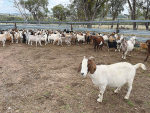
The Australian goatmeat industry set a new record for production and exports last year.
 increase font size
 Goat meat: There are specific markets for different sized goats with traditional ethnic preferences, especially festival, needs for small goats.
Why have processor/exporters not encouraged more goat meat when it sells at comparable retail prices to lamb in USA?
This was me first question in my last article. Read 'What about the potential of goat meat exports?' here.
Goats have negatives for the processors. They are not easily handled in the yards to separate lines. Plant operations are affected by different sized animals in a line that slows chain speed and supplied numbers may not match bookings.
With a total NZ goat kill about 120 000 head, spread over several plants, the relatively small numbers do not produce enough by-products to market at profitable prices. So, these end up as pet food, even while there is a premium – such as $US6 per lb for kidney and liver. Goat skins have the same problem – with low interest from buyers in relatively small numbers of variable sizes and qualities.
There are specific markets for different sized goats with traditional ethnic preferences, and especially festival, needs for often small goats. Yet a specific processing issue is small kids are expensive to slaughter with no sale products other than meat.
However, in the US live auction market of 21- 25- 28 kg LW kids there was a 2.5-5% value discount at each step as weight increased. While at 38kg LW or 17 kg CW, kids were discounted by over 15% indicating that market premium for light animals could help to counter higher processing costs.
Traditionally, some processors have successfully used goat slaughter as a plant management strategy to occupy staff and spread overheads during down times with other stock. Fabrication is simple and cheap; with either whole carcases or six-way cuts – no costs for added value, frozen storage and no trade restrictions.
Outside of supplies to a couple of traditional markets, meat is often spot traded – influenced by storage space priority, product competition, supplies, exchange rates and other marketing dynamics. Delivery can be simple by including goat with other frozen meat products.
However, such a processing regime prioritises other stock; so limited goat slaughter times can disadvantage goat farmers. Changing any of this – to access and develop one of more market segments for higher prices – needs farmers to commit to and address processing problems and supply specified numbers of standardised sized stock in identified lines.
These issues can be solved with better co-ordination and cooperation. Higher market returns would encourage more slaughter numbers to slowly overcome by-product and skin limitations and enhance returns.
About the author
Garrick Batten has a long professional and practical career in the goat sector. He has farmed goats for 30 years and written several goat books. His latest book is: ‘Big Buck$ for Pastoral Farmers’. It is especially for livestock farmers new to commercial goat farming. It is available from: https://www.copypress.co.nz/real-nz-books
The Australian goatmeat industry set a new record for production and exports last year.

Last month's inaugural New Zealand Cashmere Conference saw the opening of a new fibre processing facility.
Hill country farmers cannot ignore the goat meat market opportunities such as in North America, according to goat farming expert Garrick Batten. He outlines why in the third of his three part series on the topic.
The US goat meat market provides profitable potential for NZ hill country farmers, in Garrick Batten's opinion. From his extensive industry background, he discusses this potential in the second of three articles.
Former All Black Kevin Schuler says diversifying the family farm with his brother Paul into three milking systems – cows, goats and sheep – is all about creating a better and stable business.



Now in its fourth year, the 2026 Fencing Industry Awards, formed part of the proceedings of the FCANZ Conference, held in Nelson during August.
DairyNZ deputy chair Cameron Henderson has been re-appointed unopposed for another term.
OPINION: The stats speak for themselves.
Farms across the upper North Island are trialling different pasture mixes as part of a research programme that aims to build greater resilience into farming systems.
Election years are always a concerning time for farmers, according to DairyNZ chair Tracy Brown.
The Ballance Farm Environment Awards are coming to the West Coast of the South Island.