Rabobank Launches HortPathways for Emerging Hort Leaders
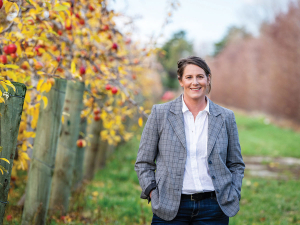
Twenty-eight emerging leaders from across the horticulture sector spent two days last month learning valuable skills and connecting with industry experts.
 increase font size
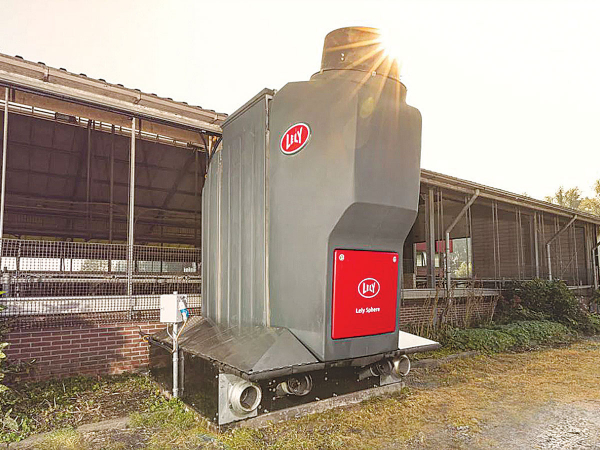 Lely Sphere claims to reduce nitrogen emissions by 70%.
Three major Dutch agribusinesses are joining forces to reduce nitrogen emissions at dairy farms.
Farmer owned dairy co-op, FrieslandCampina, Rabobank and Lely have formed a partnership for the installation of 96 Lely Spheres, spread across all Dutch provinces.
The Lely Sphere is an installation that reduces nitrogen emissions by up to 70% in the barn of a dairy farm.
The three parties hope that after this pilot project the concept will be applied on a broader scale in the sector.
The Lely Sphere is a circular barn system that separates solid manure and urine and converts nitrogen emissions into valuable fertiliser. These can be reused by the farmer for precision fertilisation on the land. In this way a more closed mineral cycle is achieved, the use of artificial fertiliser decreases and the climate in the barn improves.
Recent scientific reports show that with the Lely Sphere, ammonia emissions are reduced by up to 70% in the barn.
With this partnership FrieslandCampina, Rabobank and Lely want to make the investment in a Lely Sphere accessible for farmers. FrieslandCampina will provide a financial contribution to the farms, Lely gives a discount on the purchase of the system and Rabobank offers a loan with advantageous conditions.
The parties say they trust that this initiative will also encourage regional and national authorities to take initiatives to stimulate sustainable agriculture through innovation, and to make the necessary financial resources available.
FrieslandCampina chief executive Hein Schumacher says the co-op always looks at how it can contribute to making the sector more sustainable through technology.
“With the Lely Sphere we achieve an immediate and proven nitrogen reduction,” Schumacher says.
“We believe that this is a more sustainable and future-proof solution for the Netherlands than an expensive buy-out scheme.
“With this we want to encourage the government to take on this approach and invest in farmers who want to make their farm management more sustainable.”
Lely chief executive André van Troost says, together with FrieslandCampina and Rabobank, they want to contribute to alternatives for the current government plans regarding the national nitrogen challenge.
“Instead of reducing livestock and compensating dairy farmers for this, we believe in investing in research and technical innovations to stimulate circular livestock farming and make agriculture more sustainable.
“With this partnership we make the investment in the Lely Sphere more accessible for farmers, enabling them to work towards a sustainable future for their business.”
Rabobank deputy director Food & Agri Martine Boon says that innovation is important for farmers, in order to become more sustainable and to continue farming.
“This initiative is not only a great collaboration but also one of the solutions to the current nitrogen problem.
“Rabobank is happy to contribute to this, in this case, by offering an interest rebate and a grace period for the farmer. This gives them more financial space to become more sustainable.”
Farmers can now sign up to participate in the programme. The cooperating partners expect to install the first Lely Sphere’s after the European summer.
Early next year, the results of the pilot will be evaluated.
Twenty-eight emerging leaders from across the horticulture sector spent two days last month learning valuable skills and connecting with industry experts.
In the beautiful, scenic expanse of Invercargill, Joanne (Jo) Crack of Southern Star Farms is redefining what it means to run a modern, self-sufficient dairy operation.
A 'tsunami' of milk from key exporting countries is winding down and this may be good news for New Zealand dairy farmers.
In Dacre, near Invercargill in New Zealand’s South Island, Bruce Dinnington is running a dairy operation unlike any other.
Chinese beef trade quotas and a looming suspension of Brazilian beef imports into the European Union are expected to reshape global beef trade flows over the remainder of 2026, with implications for New Zealand exporters, according to Rabobank's Q3 Global Beef Quarterly report.


National’s pledge to introduce 19 new national standards shows the party is serious about getting Wellington out of farming, Federated Farmers says.
The National Party’s policies to make it easier to grow fresh vegetables, secure reliable water and energy and simplify farm planning are practical changes that will give growers the confidence to invest, according to Horticulture New Zealand (HortNZ).
Fonterra Co-operative Group chief financial officer Andrew Murray has resigned to take up a role outside the dairy giant.
A major move is about to get underway to improve the quality and viability of dairy beef and cattle in NZ.
Veterinarians say changes to the code of welfare for dairy cattle provides a positive foundation for improved cattle welfare across the country.
Today, 15 October, is the International Day of Rural Women, which recognises rural women’s contribution to farming, communities and the environment.




