Tough times for mixer wagon maker
Up to 50 jobs look likely to be axed at Irish mixer wagon manufacturer Keenan, who have weathered the post-Covid storm with some difficulties that saw production and profitability compromised.
 increase font size
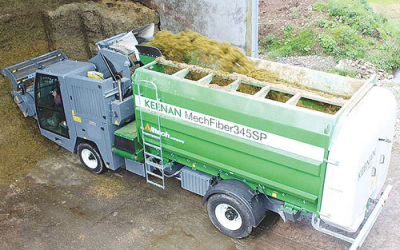 Keenan’s self-propelled diet feeder/mixer.
New from Irish manufacturer Keenan is a self-propelled diet feeder/mixer built with its Italian partner Storti.
The collaboration sees the Italian specialist build the chassis, running gear and loading arm, and the boys from Ireland dropping a 16 or 20m3 MechFiber mixer tub (as used in its trailed range) onto the rear.
Power comes from a 4-cylinder, 4.5L FPT engine producing 170hp using SCR to deliver Stage IV emissions compliance.
It is mated to Storti’s own design mechanical transmission, said to be up to 25% more fuel efficient than hydrostatic drivelines. The system has an extended service interval of up to 1000 hours.
Hydro-pneumatic suspension is fitted to the front axle for a smoother ride, machines of all specs get stability control, and Plus versions can travel at 40km/h.
At the front end, the integrated loading arm can reach to 4.5m, carries a cutting drum fitted with 84 blades and is controlled via a proportional joystick by the operator.
Depending on the material being loaded, the drum rotates counter-clockwise for the likes of maize or cereal silage, or clockwise for longer crops such as grass silage or hay. The latter function is said to eliminate blockages in the mouth of the crop conveyor. In either case, the firm closed finish at the clamp face is said to help reduce secondary fermentation and eliminate wastage.
Chopped material is fed by the central conveyor over the full length of the mixing tub. The manufacturers claim that as the material is loose when it enters the tub it is easy to mix, resulting in time and fuel savings over bulk loaded commodities. Loading, mixing and feeding a mob of 80 cows is said to take only about 18 minutes.
Like existing Keenan trailed feeders, a heavy-duty oil immersed chain at the rear drives a six-paddle mixer system with fixed knives and a full-length discharge auger, and delivery to either side.
A centrally located greasing bank should help simplify daily maintenance. Though the operator cab can’t be described as luxurious, it is like that of a telehandler – functional and offering good forward visibility.
All mixer functions are controlled by the Intouch box, including mixing and weighing, with the latter being calculated by a NIR sensor mounted at the loading drum.
Up to 50 jobs look likely to be axed at Irish mixer wagon manufacturer Keenan, who have weathered the post-Covid storm with some difficulties that saw production and profitability compromised.
With travelling irrigators being the preferred choice for dealing with dairy farm effluent in New Zealand, the sight of effluent tankers or manure spreaders is a relatively rare one.
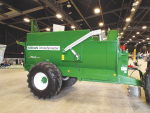
One of the more interesting first-time exhibitors at National Fieldays was Storti, from Verona, NE Italy, showing a self-propelled, self-loading mixer wagon. This large machine was catching the eye of large scale dairy farmers.



OPINION: In politics, credibility is and should be big. It must surely rank higher than charisma, which is quite trite and superficial. Yet, voters nowadays are often wooed and influenced by how someone looks or talks at a superficial level. TV plays a huge role in this.

Farmers can spend less time on paperwork, thanks to a new data sharing agreement between DairyNZ’s DairyBase and LIC’s MINDA software.
Kaikōura families affected by July's severe storm have found a practical solution to a problem that's kept some children away from regular schooling for weeks: a washed-out section of Inland Kaikōura Road, which has stopped the local school bus from running its usual route.
Rural New Zealand is welcoming the Government’s recent package of rural healthcare initiatives.
Interest in agritech and production animal systems has prompted Massey University's School of Agriculture and the Environment to new majors to its popular animal science degree.
Ballance Agrinutrients chief executive Kelvin Wickham says despite a tough year, he is pleased the business has returned to profit.