DairyBase and MINDA Link Up to Cut Farmer Paperwork
Farmers can spend less time on paperwork, thanks to a new data sharing agreement between DairyNZ’s DairyBase and LIC’s MINDA software.
 increase font size
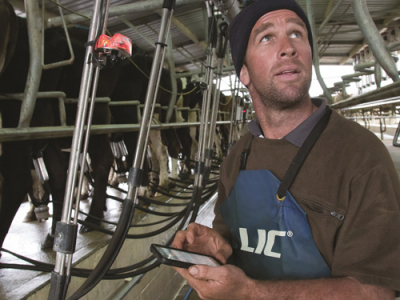 A new app for farmers has been launched by LIC Automation to help those with CellSense in-line sensors to more easily manage mastitis in their herd.
A new app for farmers has been launched by LIC Automation to help those with CellSense in-line sensors to more easily manage mastitis in their herd.
CellSense is an automated in-line sensor providing farmers with a live somatic cell count (SCC) result within two minutes of cupping the cow. The new CellSense Connected app sends the SCC results straight to farmers’ smart devices. Data is presented in an easy-to-use format on the farmers’ devices (phones and tablets), allowing them to assign a SCC result to a cow during milking.
This means farmers can view reports at their convenience and use them to aid dry off decisions. A flashing light system in the milking shed is an optional extra that alerts farmers to which cows in the herd have a high SCC.
Paul Whiston, LIC Automation’s chief executive says it heard from farmers they wanted an affordable solution enabling better mastitis management.
‘Until now, a herd identification system had to be fitted in the shed so the data from the sensors could be stored. CellSense Connected means no herd identification system is needed. It puts the farmer in control of what is and isn’t recorded.”
The app has been designed for farmers who run smaller operations and are looking for a cost-effective way manage mastitis. LIC Automation have found through on-farm trials that farmers are mainly concerned with the cows that have a high SCC level and tend to record only the outliers in their herd.
CellSense Connected integrates to LIC Automation’s Protrack, allowing farmers to schedule drafts from the app. It is suitable for both Herringbone and Rotary sheds and connects to other LIC Automation products.
Farmers can spend less time on paperwork, thanks to a new data sharing agreement between DairyNZ’s DairyBase and LIC’s MINDA software.
An LIC bull, Tronnoco AR Sadio-ET S3F, bred by Tony and Keri O'Connor of Tronnoco Farming Co Ltd near Timaru, has won the 2026 Mahoe Trophy.
Bovine Viral Diarrhoea (BVD) is estimated to cost New Zealand's dairy and beef industries more than $150 million every year, yet many of the tools needed to control it are already well understood. After more than 25 years in veterinary practice, Andrew Weir, animal health technical specialist at LIC, has seen firsthand the impact BVD can have on herd performance. We asked him about the role of persistently infected (PI) animals and the practical steps farmers can take to reduce their risk.
In the past, a bull could sit comfortably in a breeding team for several years with little change, but today, that’s no longer the case.
Paynes Titus Excelsior ET, an LIC bull bred by Brad Payne and Claire Brodie in the Waikato, has won the JT Thwaites Sire of the Season 2026 Award.


An Auckland gelato shop and an established New Zealand ice cream maker have both been named Supreme Champions at the NZ Ice Cream & Gelato Awards 2026.

As the cost-of-living crisis continues to put pressure on household grocery budgets, new figures show pork remains one of the most affordable fresh meat options for New Zealand families.
OPINION: In politics, credibility is and should be big. It must surely rank higher than charisma, which is quite trite and superficial. Yet, voters nowadays are often wooed and influenced by how someone looks or talks at a superficial level. TV plays a huge role in this.
Farmers can spend less time on paperwork, thanks to a new data sharing agreement between DairyNZ’s DairyBase and LIC’s MINDA software.
Kaikōura families affected by July's severe storm have found a practical solution to a problem that's kept some children away from regular schooling for weeks: a washed-out section of Inland Kaikōura Road, which has stopped the local school bus from running its usual route.
Rural New Zealand is welcoming the Government’s recent package of rural healthcare initiatives.