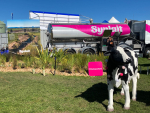
What Would Synlait Be Worth to Fonterra or a2 Milk?
Speculation of a possible joint move by Fonterra and a2 Milk to buy Synlait raises a much bigger strategic question, says agribusiness expert Dr Nic Lees.
 increase font size
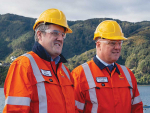
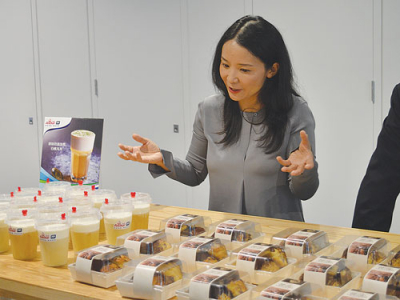 Fonterra Greater China president Christina Zhu in Auckland last week.
Exactly five years ago Fonterra launched its first Anchor milk product in China, today it is sold in 13,000 stores in 220 Chinese cities.
A 250ml Anchor UHT milk produced at the Waitoa site went on a retailer’s shelf in Shanghai. This was followed by a joint online and offline push into the China market and today Anchor is the number-one consumer milk brand.
Anchor UHT milk is also the online bestseller in China with 55% of total sales made online.
Fonterra Greater China president Christina Zhu, in Auckland last week to celebrate five years of Anchor milk brand in China, says Anchor now offers 47 products to consumers.
These include high value milk foods, organic milk, infant formula, fresh milk, butter and yoghurt.
Zhu says the 45% vs 55% offline/online sales mix is working well.
“A lot of fast moving consumer goods (FMCG) companies would kill for this mix in China,” she says.
Cumulatively 1 billion glasses of milk have been sold by Anchor in China since its launch.
Zhu says fighting for market share isn’t easy with 64 imported milk brands in China, but Anchor is proud to be retaining the number-one spot. Anchor sales have grown 40% year-to-year, not easy from a small base. She adds many FMCG companies are not growing in China.
“Some of the global FMCG brands are declining in China; the 40% plus growth is huge; in fact it makes a lot of people very jealous of us in China.”
Zhu pays tribute to her workforce; volume per person has increased seven times since 2014. “Things don’t fly off the shelf; in China it requires a lot of hard work.”
From day one e-commerce has been part of Anchor milk’s strategy and ‘genetics’ in China. Fonterra works with China’s two giant e-commerce retailers Alibaba and JD.com.
China’s internet usage is astounding -- 770 million internet users. Online sales last year topped US$812 billion, versus US$821b in the US, UK, Japan, Germany, Korea and France combined.
Own processing?
Fonterra is pondering building plants in China for processing milk from its farms there.
Christina Zhu says third-party manufacturers now process fresh milk from the 28,000 cows on its two farming hubs; a third hub is being built with global food company Abbott.
““We have farms, we have a big downstream business and we need manufacturing capability. Right now, it’s done at a few carefully audited third-party sites and we have Fonterra people working on these sites fulltime to make sure the products are safe,” she said.
“There is a natural cap on how much you can do through third parties, so we’re assessing all the options, but we’re not in a position to say a definite timeline or make a commitment at this point.”
Fonterra’s greater-China sales are at least $5 billion; foodservice and ingredients make the most. But China farms have bled money over the years and Fonterra’s investment in food company Beingmate has turned sour.
Zhu says Beingmate gets a lot of attention but is a very small part of the total China business. “We are obviously disappointed; the business is not where we want it to be. But we are working closely with the new general manager to turn it around.”
Speculation of a possible joint move by Fonterra and a2 Milk to buy Synlait raises a much bigger strategic question, says agribusiness expert Dr Nic Lees.

In the past, much has been made of the concept of farm to fork, but an Australian expert in food science and marketing with experience in the dairy industry, Dr Angeline Achariya, says the reverse of this slogan is critical to win modern day consumers.
A four year trial has reaffirmed that mixing plantain into dairy pastures can help reduce nitrogen losses to freshwater while maintaining milk production and profitability, say researchers.
Fonterra has opened its upgraded Chengdu Application Centre, bringing New Zealand dairy expertise closer to customers in one of China's fastest-growing regions.
Tatua chair Stephen Allen says he leaves the co-op with a deep sense of gratitude for the people who have contributed to its success.

A partnership between state-owned enterprise Pāmu (Landcorp Farming Limited) and charity Meet the Need is putting more than quality New Zealand beef into food bank parcels this year.

The Opportunity Party has faced criticism during the election campaign that its policies are too urban-focused and offer little for rural communities.
The chair of the country's environmental regulator, the Environmental Protection Authority (EPA), says changes are already under way to improve the performance of the agency to better meet the needs of those who interface with them.
Alliance Group's $16 million programme to install innovative heat pump systems at its Otago and Southland processing plants wins a New Zealand Energy Excellence Award after cutting annual emissions by more than 24,000 tonnes of CO₂e.
The arable sector losing good people and land is a major concern for the 2026 Arable Farmers of the Year, Mid Canterbury seed growers John and Mel McCaw.
The terrible floods that hit the Wairarapa may have subsided, but the danger to farmers still exists, according to local Federated Farmers president Rob Hickson.