What Would Synlait Be Worth to Fonterra or a2 Milk?
Speculation of a possible joint move by Fonterra and a2 Milk to buy Synlait raises a much bigger strategic question, says agribusiness expert Dr Nic Lees.
 increase font size
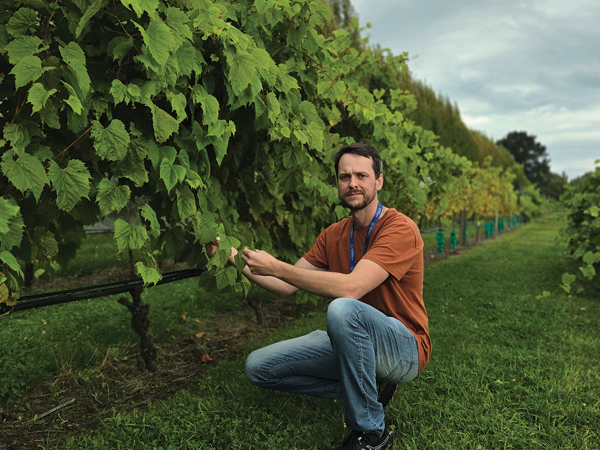 Dr Jean Carlos Bettoni
A Lincoln University research fellow is working to safeguard grapevine species from extinction, using careful science and liquid nitrogen.
Dr Jean Carlos Bettoni is a specialist in cryopreservation, through which a tiny piece of grapevine is propagated in a tissue culture, before a millimetre of material is removed, dehydrated, locked in an airtight container and immersed in liquid nitrogen, where it can stay indefinitely, if topped up. When it’s needed, the vine material can be propagated in the lab with a relatively high success rate.
Lincoln University has some unique grape varieties from around the world, which could be threatened by plant disease and climate change. “We have few plants of some varieties, and we don’t want to lose that biodiversity,” Jean says. “The main goal of cryopreservation is to have a safe collection, in case anything happens, so future generations will still have the opportunity to take advantage of it.”
Jean is also a specialist in virus eradication, including the use of cryotherapy; which works by exploiting which cells a virus infects. When the shoots are immersed in the liquid nitrogen, the freezing temperatures destroy all of the outer cells, which is where most grapevine viruses reside. The cryotherapy methodology has been successfully applied to eradicate viruses and viroids in diverse crops, including apple, kiwifruit, potato, and quince, Jean says. “We’re 100% confident that we are able to remove the virus.”
Jean has extensive experience working in the field, having contributed to the creation of the world’s first grape species cryobank for the United States Department of Agriculture at the National Laboratory for Genetic Resources Preservation in 2019-2020, led by Dr Gayle Volk. His expertise recently led him to serve as a consultant for the FAO (United Nations), where he helped establish international standards for gene bank conservation through cryopreservation.
He started as a Postdoctoral Research Fellow at Lincoln University late last year, working with Dr Olaf Schelezki and Associate Professor Amber Parker, and has a long-term goal of developing a cryopreservation facility at Lincoln. “A
more immediate and feasible aim is to establish a secure backup in tissue culture and then use cryopreservation as a tool to eradicate viruses.”
Speculation of a possible joint move by Fonterra and a2 Milk to buy Synlait raises a much bigger strategic question, says agribusiness expert Dr Nic Lees.
Lynnette Hudson's 30-year obsession with Pinot Noir was sparked working vintage in Burgundy, seeing how subtle changes in terroir were expressed in the glass. It was, she says, "an elightening moment in every way".
A four year trial has reaffirmed that mixing plantain into dairy pastures can help reduce nitrogen losses to freshwater while maintaining milk production and profitability, say researchers.
Twenty five secondary school students from around New Zealand recently completed a three day residential programme designed to explore career opportunities across the food and fibre production supply chain.
A Lincoln University student is set to become the first person to contest both the Young Viticulturist and the Young Winemaker national titles in one year.


