As drones get bigger, broadacre applications like arable spraying will become more common, says the Canterburybased founder of Drone Spray, Jono Scott.
“Drone spraying is on the rise across all sectors and agriculture is no exception.”
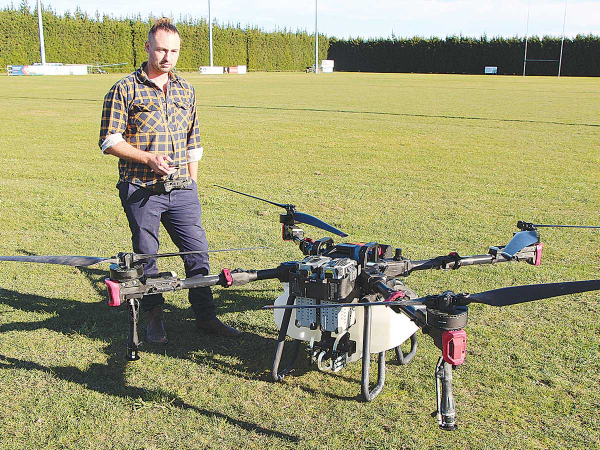
Drone Spray carried out a demonstration for arable growers in an event organised by a Foundation for Arable Research grower group focused on future proofing farm systems. Held at the Dunsandel rugby grounds, its goalposts, sports floodlights and surrounding hedge were no obstacle for the flying drone.
Scott says that arable applications are increasing as drones get bigger and more efficient. His XAG P100 Pro drone, built specifically for spraying and seeding, has a 50-litre tank and can cover up to 14 hectares an hour. In comparison, when he started his business two-and-a-half years ago, his first drone had a 16-litre tank.
“Lower water rates are a key factor to the efficiency of spraying by drone. For some applications we can spray as low as 25% of the water rate of a helicopter operator. This is due to the even droplet size of the atomising spray nozzles and precise, even application.”
In future, he expects drones and their capacity to get bigger as batteries improve. Drones will also incorporate more smart technology for applications such as spot spraying of weeds.
While arable farmers will continue to use ground spraying rigs, drones provide an alternative for aerial spraying. Spraying by drone has strong advantages in paddocks with hedges, trees and high wires or when crop or land damage is best avoided. Drones can also be used at night.
“It is a similar pricing to a helicopter, but more accurate, particularly around the edges,” Scott says.
While wind can be an issue, similar to other spraying applications, drone operators have ways to limit drift on the boundaries, such as going slower, flying lower and increasing droplet size.
Before a job is started, an automated flight path is prepared for the drone which sets a pre-planned route, boundary limits and no-go areas around any obstacles. Parameters like height, width, speed and nozzle spray settings can be adjusted during flight.
Drones used by Christchurch-based Scott and his Methven-based colleague Scott Rix can spray a width of five to eight metres, depending on the height that the drone is operating. The drones operate at a height of around 3m for general crop spraying and around 5m on hilly terrain for woody weeds such as gorse and wilding pines, and roof spraying. The strong downwash from the propeller blades ensures all the spray reaches the target area.
A spreading and seeding attachment is available for slug baiting, spreading and hill seeding. FAR technology manager Chris Smith says that drones offer another tool in the application toolbox and are particularly useful in areas that are challenging for a ground sprayer, but adds there are issues to consider.
“While drones have their place and are becoming a commonly used method of application, they may require changes to application rates, which in turn may impact on agchem efficacy and the risk of resistance in pathogen, pest and weed populations.
“Currently, chemical labels are unable to keep up with technology.”
FAR is planning to explore the use of drones for spraying at its Future Farms Systems demonstration site at Chertsey to reduce vehicle use. A drone will be used on one half of the site adopting a more experimental future-focused approach, while a ground-based boom sprayer will continue to be used on the best practice conventional arable side. Water sensitive paper will be used to analyse differences in spray coverage. Agchem efficacy will also be monitored where possible, Smith says.