Polaris unveils mid-size utility side-by-side
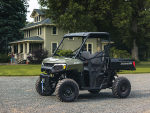
Polaris Off Road has unveiled the 2026 Ranger 500, an all-new mid-size utility side-by-side aimed at bringing the quality and reliability of the American brand into the value segment.
 increase font size
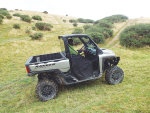
 Polaris has added to its Ranger Series of utility side-by-sides with the arrival of the new XP1000.
Polaris has added a new flagship model (XP1000) to its Ranger series of utility side-by-sides.
A ProStar 1000 engine developing 82hp is mated with a new clutch and redesigned driveline; the clutch is a large-ratio unit for low-speed drivability, and the driveline uses the strongest belt ever fitted to a Ranger.
Redesigned under-hood air intakes and a new clutch cover increase the air flow for cooler, longer belt life, and improved geometry produces less friction for increased efficiency and a quieter ride.
VersaTrac (turf mode) enables the rear wheels to rotate independently, allowing tighter turns and reduced tearing of delicate surfaces such as fine turf or compacted pathways. Using a dash switch, the driver can toggle from turf mode to 2WD (locked rear diff) to all wheel drive.
A new one-piece chassis increases stiffness and reduces flexing, making the machine stronger and more durable.
The ride is enhanced by 28cm of suspension travel, and 27-inch tyres fitted to cast aluminium rims give greater height and 33cm of ground clearance -- an increase of 8%.
For precise handling, the vehicle has a reduced steering ratio that gives a tighter turning radius; and a new front sway bar offers a more responsive ride and improved manoeuvrability.
A new distinctive grille behind an enlarged front bumper is designed for added protection, and a new full-body skid plate provides extra protection and durability.
At the rear, the cargo box has 11.5% more volume, welded steel corners for stiffness, lock-and-ride rails, eight stake pockets, moulded in-box divider slots and large, reinforced D-rings.
The Ranger XP 1000 has 1134kg of towing capacity.
Standard on all Ranger XP 1000 vehicles, the Polaris engine braking system (active descent control or ADC) ensures smooth, controlled descents on steep inclines with or without a load. ADC uses an electromagnetic coil, applying a magnetic force to a bi-directional overrunning clutch, that works with a pair of plates connected to the output hub to the front wheels and crown wheel with lock-up creating front-wheel-induced engine braking. Working in tandem with the rear-wheel EBS system, this achieves 4-wheel engine braking.
The vehicle also has three-mode throttle control -- performance, standard and work modes -- that control the power.
Getting in and out is easier with 12.7cm more clearance, and there is more legroom and more comfortable seats.
A user-friendly dash layout includes a digital/analogue gauge and four pre-wired accessory switch locations for easier accessory fitment.
A new flip-up passenger seat offers more space for buckets or the farm dog, and six cup holders should keep everyone happy.
Polaris Off Road has unveiled the 2026 Ranger 500, an all-new mid-size utility side-by-side aimed at bringing the quality and reliability of the American brand into the value segment.
When you compare a RAM 1500 or Chevrolet Silverado to a Ford Ranger or a Toyota Hilux, you will understand why we need the designations truck and ute.
Think of a RAM 1500 or a Chevrolet Silverado and compare them to a Ranger or a Hilux: One is obviously a truck, and the other is a ute.
Off-road specialists Polaris has launched a new speedcontrol and geofencing kit, aimed at keeping operators and workplaces safer by allowing users to set maximum speed limits and limit speeds in geofenced areas.
Polaris Inc has unveiled plans to debut an all-new 2022 electric Ranger utility side-by-side in late 2021.


Worst election result imaginable for New Zealand and not good for business confidence.

Associate Agriculture Minister, Mike Butterick has lost his Wairarapa seat in the final count released today.
Women across the dairy sector have an opportunity to invest in their leadership, education and professional development, thanks to a scholarship fund.
Three of New Zealand's leading primary sector organisations have joined forces to propose a new Food and Fibre Private Training Establishment (PTE).
OPINION: The World Dairy Summit, held in Auckland last week, delivered a poignant message – when it comes to global trade, the old order has passed away.
Deer Industry New Zealand (DINZ) has welcomed Government co-investment in a new $10 million programme aimed at increasing the value of New Zealand farmed venison, velvet and co-products and improving returns to deer farmers.