New Zealand and Ireland Extend $34.5m Climate Research Partnership for Agriculture
Ireland and NZ have concluded a deal to extend a joint research programme on climate change.
 increase font size
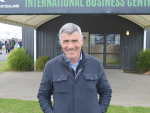
 Part of the strong Enterprise Ireland presence at this year’s Fieldays George Fleming (left) and Jason Cros.
The number of Irish tradies working in Christchurch, and those operating rural contractors' machinery and tractors at harvest time, show how much the Irish like New Zealand.
And if you're a regular at Fieldays you must have noticed the enduring presence, now in its tenth year, of Enterprise Ireland (EI), their lilting accents and everlasting smiles promoting Irish manufacturers to Kiwis.
At Fieldays 2016, 21 Irish companies were there: readily recognisable names such as Keenan and McHale, and new ones such as MooCall and Erth Engineering. The big Irish companies we know, but also notable now are the Emerald Isle firms moving in the 'tech' sphere: the software company Sixty-5, producing data for effective pasture management, and MooCall, whose device fitted to a cow's tail wirelessly advises farmers of imminent calving.
Mary Kinnane, EI's director Australia and NZ, says "despite popular belief, Ireland is one the fastest growing economies in the Europe".
"We share strong historical connections, innumerable social and cultural ties, and in some cases deep personal ties with NZ – which make us want to do business in this great country.
"Our presence allows Irish businesses to promote their products to potential customers and showcase the innovation, quality and enduring commitment to the market and, most importantly, to learn from one another."
EI companies increased exports 10% in 2015 to a record Euro 20.6 billion (NZ$32bn) – almost double 10 years ago. This creates jobs in a country with 7.8% unemployment and a minimum wage of Euro 9.15 (NZ$14.45) per hour.
EI participates at every stage of companies' growth – commercialising research, investing equity in start-ups, stimulating the venture capital ecosystem and promoting sales in overseas markets such as NZ.
The Irish brigade showed off a diversity of products and company longevity.
For example, Jason Cross fronted for his family's company Cross Agricultural Engineering, formed in 1987, making slurry pumps and tankers and a range of fodder beet cleaning machinery. These are finding favour in a fast growing NZ market and Cross spends many weeks here each year promoting them.
At the other end of the spectrum George Fleming heads Flemings Agri, a business 150 years old, spanning five generations building products such as trailers, bale handlers and rollers.
"Our business is based on the premise that we build implements people will always need for day-to-day farming, that are well designed and manufactured and won't break the bank," Fleming says.
He visits NZ three times a year to support his importer Toplink Machinery and its dealers, and although he's approaching the big '6-0' shows no signs of slowing down.
The Irish/Kiwi partnership is undoubtedly an enduring one. All week the pubs in Hamilton were bustling with those who share the Irish love of "the Craic", as faithful Fieldays attendees recognise familiar faces and old friends from previous years.
Ireland and NZ have concluded a deal to extend a joint research programme on climate change.
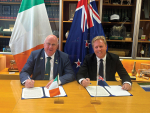
Ireland's Minister of state for Agriculture says it’s hard to explain to Irish farmers the size and scale of NZ farms.
The Irish Minister of State for Rural Communities says his country and New Zealand face very similar challenges on a range of issues related to agriculture, including climate change, biodiversity and rural depopulation.
In the rural landscapes of New Zealand and Ireland, a shared agricultural heritage thrives, built on a strong mixture of tradition and innovation, with mirror image climates earning both countries global acclaim for their food quality and sustainable agriculture.
MPI director general Ray Smith reckons NZ has a lot to learn from the Irish Agriculture and Food Development Authority – called Teagasc (pronounced ‘Chog us’).



Federated Farmers has welcomed new rural policies released by ACT, saying they align closely with its own election priorities.

Rural Contractors NZ says proposed changes to land transport rules for agricultural vehicles are a welcome response by the Government to out of date regulations which have seen members hit with huge fines.
Alliance is calling for final applications for its 2027 Graduate Programme, with applications closing on Sunday 25 October.
Decades piloting planes has ensured vet and farmer David Hayes is focused on safety. So, after a serious accident while welding on farm, he is sharing his experience so others can learn from it.
Canterbury milk processor, Synlait Milk has confirmed Leon Fung as its chief executive officer.
OPINION: Making it easier to collect rainwater and use it to grow crops and livestock is a no brainer.