Case IH Unveils Next Generation Puma Series Tractors
Case IH has unveiled its redesigned next generation Puma Series tractors, said to offer improvements in connectivity, operator comfort, fuel efficiency and drivability.
 increase font size
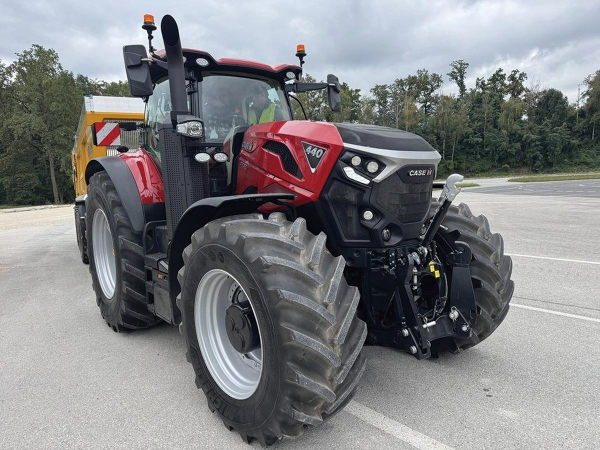 Case IH’s Optum Series is expanding, with a lighter, more compact, faster vehicle in the pipeline.
Currently available in New Zealand in 250, 270, 300 and 400 horsepower options, Case IH’s Optum Series is being readied for expansion with the announcement of three new additional models, the 360, 390 and 440.
Said to be completely new, apart from the cabin, the company appears to have recognised that while the Magnum Series offering 310, 340, 380, and 400hp is an extremely capable prime mover – especially for cultivation – farmers and contractors are asking for a more road friendly, versatile workhorse.
While the new series has a longer wheelbase than Magnum (it is 100mm shorter overall), the project, started in 2021, was to build a lighter, more compact, faster vehicle, also more suited to working with front-mounted kit.
Up front, a new independent front suspension layout uses a CNH axle which offers anti-roll, pitch and dive alongside 250mm of travel. The axle incorporates the brakes from the rear end of a Maxxum, for increased stopping power, while the exhaust brake (offering about 28% braking effect) has been complemented by a decompression system on the engine, that opens valves, rather than allowing the exhaust gas pressure to push the piston down, which results in 166% braking.
Rather than using a chassis, the sump of the 8.7-litre, six-cylinder FPT Cursor 9 engine forms the structural component, reducing weight, but also helping the bigger Optums turn in a 14.5m circle. Both SCR and a DOC are used for Stage 5 emissions, with service intervals at 750 hours to tie in with the 1500 hours transmission and hydraulic system intervals.
Equipped with a larger version of the 4×2 CVXDrive box found in the existing Optum, one key difference is the ability to travel at 60km/h at 1900rpm, depending on local regulations.
The bigger Optums are available with larger tyre options, with the option of a central tyre inflation system, using a gear driven compressor, capable of delivering one bar inflation in five minutes. The system offers two field and one road pressure settings. Working weight of the flagship Optum 440 is around 12,450kg with a max permissible weight of 19 tonnes (depending on local markets).
At the business end of the tractor, rear pto speeds are offered with 540E/1000 or 1000/1000E formats, while the front pto is also a two-speed 1000/1000E unit. Rear hydraulics are 220 l/ min output as standard, with the option of an additional 140 litre/min pump for a total output of 360l/min. With the twin pump arrangement, one supplies oil to the left side couplers, the other for the right. The layout allows one pump to be high pressure, the other low pressure as required.
Although offering the same structure, cabins have been upgraded to include suspension options and other improvements such as walk-in entry steps, integrated toolbox storage, and a built-in water tank hand-washing.
Production is expected to commence in mid-2026, although at this stage, pricing and availability are yet to be confirmed for ANZ.
Case IH has unveiled its redesigned next generation Puma Series tractors, said to offer improvements in connectivity, operator comfort, fuel efficiency and drivability.
While it took some time for Wakanui farmer Eric Watson to get the tracks dirty on his new Case IH AF10 combine, he says it was worth the wait, with the challenging conditions really putting the new machine through its paces.
While equipment sales teams bask in the glory when they sell a product, they often forget the designers and engineers who bring that product from an idea to production.
The Case IH Farmall C, well known across New Zealand, has just seen an upgrade including a new look, increased weight and hydraulic power, and a cab overhaul.
Case IH has released details of its all-new round balers and redesigns to its large square balers aimed at increasing productivity.



Entries opened on Monday, 5 October 2026 for the 2027 New Zealand Dairy Industry Awards (NZDIA), which organisers describe as the nation's biggest celebration of excellence in the dairy sector.
Waikato milk processor Tatua has again declared a record milk payout to farmer shareholders, leaving other processors in the dust.
A Labour-led Government won’t be bringing back the controversial freshwater rules of 2020.
National’s much-touted free trade deal with India featured in the Rural Issues Debate at Mystery Creek, Hamilton on Wednesday night.
New Zealand's 2026-27 freshwater fishing season has opened, with anglers encouraged to head to rivers and lakes over the coming days as conditions look favourable across much of the country.
Central Otago District Council (CODC) has voted against a plan to spread treated sewage sludge from Cromwell and Alexandra on farmland near Lauder, a decision Federated Farmers says reflects strong opposition from rural residents.