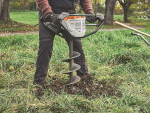
Stihl Launches BT140, Its First Battery-Powered Auger
With battery tools becoming more widespread and more importantly, productive and reliable, it was only time before we saw augers or post-hole borers.
 increase font size
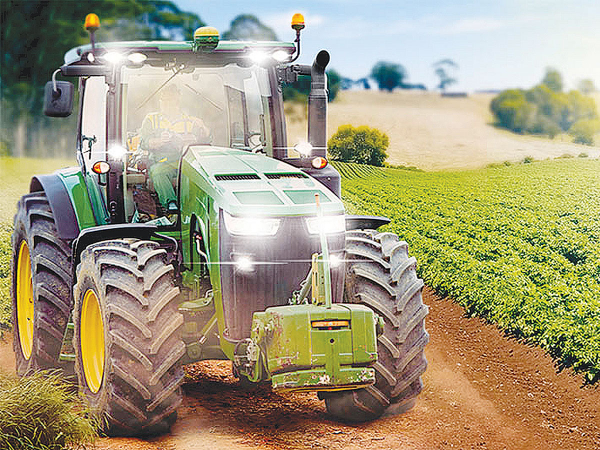 BKT has plans to make 600,000 tonnes of tyres each year from 2026.
Indian tyre manufacturer BKT has plans to make 600,000 tonnes of tyres each year from 2026, when annual turnover is forecast to hit US$2 billion.
Already on a roll, BKT’s business has increased by 49% over the pre-pandemic period and expansion at the company’s prestigious Bhuj production plant in India will play a major role in increasing tyre numbers.
When the first tyres rolled off the production line in 2012, the Bhuj site covered 123ha. With more than US$500m invested over the ensuing years, the site has grown in stages to its current size of 258ha in 2022. Expansion plans mean it will expand even further to hit 323ha by the end of 2023.
The ambitious expansion plans means a major increase in staff numbers from the 4,776 people employed at the end of 2022. Meanwhile, the extra footprint being planned is needed to install the new machines needed to increase the volumes. These have risen from 92 tonnes a day in 2015 to the best-ever, 436 tonnes a day by the end of the 2022 year.
The expansion will also include a dedicated rubber track manufacturing plant, alongside space for six different test tracks. These will include circuits for performance tests on a variety of different surfaces in dry and wet conditions. These will offer the ability to measure parameters such as traction, handling, comfort and soil compaction.
A further strategic choice at the Bhuj site MARK DANIEL This email address is being protected from spambots. You need JavaScript enabled to view it. was to invest in its own carbon black plant, which came into operation in 2017. This has led to a current total annual production of 165,600 tonnes of the essential tyre component.
“People have asked me if all this was really necessary, so much in such a short time?” explains Rajiv Poddar, joint managing director at BKT.
“Growth has always been in step with demand.
And we see global tyre demand growing, with no signs of it slowing down over the next five years. The journey we started out on at Bhuj in 2012 was never a return journey, but one to prepare ourselves to discover the future.”
With battery tools becoming more widespread and more importantly, productive and reliable, it was only time before we saw augers or post-hole borers.
Austrian manufacturer Pottinger has released details of a new compact, linkage-mounted compact twin rotor rake, without a chassis, that is said to deliver impressive manoeuvrability.
The new Lemken Saphir XMR mechanical seed drill has been introduced as the successor to the proven Saphir 10m, with the manufacturer claiming new standards for precision, ease of use and area coverage.
Krone's XDisc 710 direct-cut header can now be used by John Deere and New Holland forage harvesters, as well as the Krone Big X it was originally designed for.
Fifty Eight years ago, on the 16th of August 1968, August Claas, the founder of the harvesting company and father of Helmut Claas, personally presented a Claas Senator combine harvester to Scottish farmer John Steven.


Farmgate lamb prices are down by 8%, beef cattle by 4.5% and farm expenditure up by 4.2%.
Kiwifruit growers are watchful but remain optimistic as concerns around the potential effects of the El Niño weather pattern this season.
Almond hulls sourced from Australian orchards may have the potential to help New Zealand cows reduce emissions, boost milk yield and lower input costs.
Striking a balance between meeting the needs of industry to speed up approval time for products but on the other hand ensuring that risks are properly assessed.
Surprised, humbled and quite thrilled. That’s the reaction of James Allen, one of the founding partners and now chief executive of AgFirst, on being made a life member of the Institute of Rural Professionals.