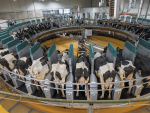
Robotic Rotary Milking: Inside a $6M Investment Paying Off Faster Than Expected
The Dairy ProQ robotic rotary, the first of its kind in the Southern Hemisphere, has proven to be an impressive addition for Victorian farmers Paul and Marsha Smith.
 increase font size
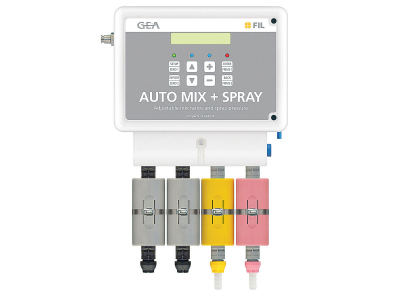 GEA Auto Mix + Spray.
An intelligent new Auto Mix + Spray unit from GEA’s FIL division is said to set a gold standard in teat spraying, providing farmers with an accurately mixed solution applied ‘fresh’ at every milking.
Accurately mixing and using teat spray to combat seasonal differences is the critical factor in maintaining teat condition, says FIL national manager Colin May.
“Farmers might be using the best products, but teat spray solutions can vary depending on who does the mixing and their understanding of what’s required to combat seasonal differences,” he says.
“Most teat sprays suggest a mix ration of maybe 1:6 or 1:9; that can be confusing, and adding extra emollient adds yet another level of complexity”.
May says the Auto Mix + Spray unit offers 97% accuracy, so removing the human error and guesswork inherent in manual mixing.
FIL can also help farmers tailor a teat care plan including recommended mix rates to meet seasonal changes. These rates can be loaded and locked into the unit’s memory for daily use until a change of ration is required.
When environmental conditions change, or a deterioration in teat condition is detected, the unit’s settings can be altered in single percentage points from 5% - 20% to counter changing patterns of teat condition.
Being pressurised, the system can be retrofitted into a wet-it or wand system, an ambic system or on-platform spraying systems (such as iPUD) or installed as a standalone unit in the dairy shed.
The Dairy ProQ robotic rotary, the first of its kind in the Southern Hemisphere, has proven to be an impressive addition for Victorian farmers Paul and Marsha Smith.
GEA says that its latest walkover teat sprayer is helping farmers save time and boost udder health.
New Zealand farmers get their first opportunity to experience the future of pasture-based dairy automation in action this week at the National Fieldays.
Milking technology provider GEA Farm Technologies is introducing its first automatic milking system (AMS) in New Zealand.
FIL, the animal health and dairy hygiene subsidiary of GEA Farm Technologies, is dropping the price for its chlorhexidine teat spray products.



LIC shareholders have elected a new North Island representative to the co-operative's Board, along with five representatives to its Shareholder Reference Group (SRG), following the company's Annual Meeting held in Invercargill.
Farmers across parts of Southland and South Otago are continuing to deal with difficult conditions after a prolonged run of wet weather, with pressure building around feed supply, stock management, pasture damage, farm infrastructure and everyday workloads.
Federated Farmers says it welcomes Labour's commitment to reviewing the Sharemilking Agreements Act, calling on other major parties to do the same.
For Canterbury dairy farmers Sian Meijer and Rick Wobben, wearable technology has become one of their most valuable on-farm tools - helping manage 1850 cows across an expansive, high-performing dairy operation while improving efficiency, mating outcomes and day-to-day decision making.
Fonterra has unveiled its annual results for the 2026 financial year, posting $27 billion in revenue and close to $20 billion returned to New Zealand farmer owners and unit holders.
The first major update to the Dairy Cattle Code of Welfare in more than a decade has been released, marking what DairyNZ describes as an important step in ensuring animal welfare standards continue to evolve alongside scientific evidence and on-farm realities.