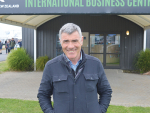
A forecast model telling orchardists and their contractors when it is a good time to apply spray won an innovation award at the recent Hawke’s Bay Primary Sector Awards.
The Spray Forecast, which combines weather data, regulatory limits and in-orchard measurements to assess optimum versus poor times to apply orchard/crop spray, is now used by over 1100 growers.
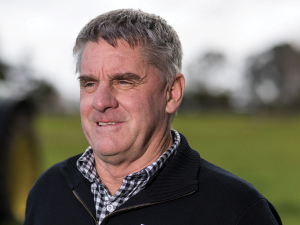
Developer Dr Mark Bart, who heads weather forecasting and data company Metris, says he’s created a hyperlocal forecast model for orchardists, viticulturists, vegetable growers and their contractors to inform when it is a good time to apply spray, and when there is high risk and therefore a poor decision.
“It sounds simple, but what’s special about it is that it takes high resolution weather forecast information, orchard level measurement data from our weather station sensor network and integrates it all with a grower’s local council regulations to set parameters that help growers make good calls,” Bart told Rural News.
“We leverage cloudcomputing infrastructure to spread the cost and risk. Metris developed software which we use to bid on supercomputer time at the right time and at the lowest cost. We then run this model in the cloud. This means our forecast product is high resolution (for orchard level accuracy), timely and cost effective for growers.
“It’s used by over 1100 people every day now as we offer this as part of our daily weather forecast service for our clients nationwide.”
Bart says the company was thrilled to win the Bayleys Innovation Award after the work that went into developing this service.
He notes that crop protection is a huge cost to all growers costing over $50,000 per application for a large grower.
It’s the second or third biggest cost to growers after labour and interest charges.
So, putting it on without wasting it, or when it can be most effective, is a big factor in decision making, says Bart.
“Our growers are aware that town is encroaching on traditional growing areas, which is a risk they have to manage as they also work to produce high-quality food.
“They’re also aware of the need to look after themselves and their staff, so need to know where any spray is going, and need to have a way of making good calls around timing.
“Society is pushing back against spray and insisting on spray reduction. Another critical reason is for growers to meet their GAP requirements, they are very aware this is the customer wanting assurance for the consumer, and it supports market access to premium markets.”
Bart is pleased with the uptake of the technology.
“It’s been excellent with over 1100 growers using it daily – sometimes several times a day. It’s had broad appeal.
“We’re seeing orchard managers and viticulturists from New Zealand’s largest well-known food and wine brands right through to smaller family-owned orchardists using this and their feedback around how it’s helped them has been great. The key feedback has been around its simplicity for staff to understand it, its timeliness and its accuracy.”
 |
|---|
|
Metris has a network of professional scientific-quality weather sensors across the country from Northland to Central Otago.
|
Weather Sensors
Dr Mark Bart started Metris seven years ago, setting up a network of professional scientific-quality weather sensors that are now across the country from Northland to Central Otago.
He says they run and maintain this as a fully-serviced data network.
“We’re collecting thousands of weather measurements and soil moisture and temperature measurements every hour. Our growers lease data off us and they can see it in real-time on their computer or phone,” he says.
“We wanted to make it easier for a grower to get soil moisture and temperature data in real-time and see it on the same dash that shows their rainfall, their irrigation, as well as their frost alerts, disease pressure alerts and other growing conditions on their orchard.
“They never have to worry about calibrating the station, fixing it, keeping the spiders out or sorting out soil moisture probes. We do all of that so that we can be sure the data we give them on their growing situation is as accurate as we can make it.”
The data is audited daily to make sure everything is working and the data is accurate and also to plan engineering maintenance.
Bart says they use the data to make daily weather forecasts and frost forecasting hyper-local and accurate so they can closely match forecasts to orchard and vineyard locations.
“We also use the network data to provide information on specific disease risks, irrigation decisions and to calculate information that growers need like growing degree days and chill units. We also serve up a range of specific data to help people plan new orchard development.”