Primary sector leaders praise speed and ambition of India–NZ free trade deal
Primary sector leaders have praised the government and its officials for putting the Indian free trade deal together in just nine months.
 increase font size
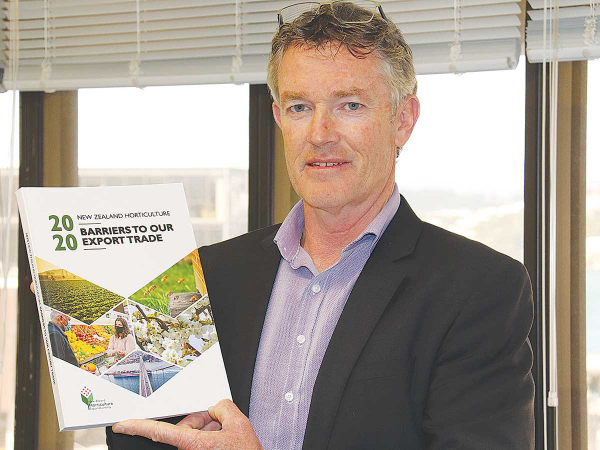 HEA chief executive Simon Hegarty says they are noticing a rise in other non-tariff measures, which is a big concern for the industry.
Horticultural exports have increased by 25% over the last two years and tariffs on these exports are down by 29%.
However, New Zealand is by no means out of the woods in terms of protectionist policies – due mainly to the coronavirus pandemic.
That’s the conclusion of a special report on barriers to NZ horticulture exports commissioned by the Horticultural Export Authority (HEA) – the organisation that represents all horticultural exporters. It shows, since the last report of this nature two years ago, horticultural exports have grown to $4.52 million. In the same period, the tariffs that NZ pays on these exports are now $152 million, down from $214 million in 2018. In those two years, kiwifruit exports in value terms increased by 36%, apples by 20%, onions 60%, avocados 15% and potatoes by 11%. However, cherries and buttercup squash exports were down.
The main focus of the report is the issue of trade barriers and non-tariff measures. It singles out India as the country which imposes the highest tariffs on our horticultural exports (43%). However, the worry for NZ, in terms of trade barriers, is our biggest single market for horticultural exports – the European Union. Currently NZ pays at least $61 million (FOB) in tariffs to the EU.
At present, NZ is in the process of negotiating an FTA with the EU and the hope is that some of these barriers will be removed, but no one it seems is holding their breath.
Simon Hegarty, chief executive of HEA, says there has been some relief from tariffs with the advent of the Comprehensive and Progressive Trans Pacific Partnership (CPTPP), which has seen 80% of tariffs to Japan virtually eliminated. Apple exports to Japan are still subject to tariffs, but these are due to be phased out over the next eight years.
FTAs with Canada, Mexico and Peru have also helped and the recent RCEP agreement will also have a positive impact on our exports with an agreement to clear goods faster at borders of participating countries.
“While we are seeing a drop in tariffs we are also noticing a rise in other non-tariff measures, which is a big concern for the industry,” Hegarty says. “Many of these are ‘technical’ barriers which get applied to our products and are unnecessary barriers to our trade.”
He says the outcome of Brexit remains a problem for NZ and warns that there will be some disruption to our exports whether there is a deal or no deal between the UK and EU. Hegarty says there are already problems in the supply chain with shipping delays and Brexit will exacerbate the problem.
Primary sector leaders have praised the government and its officials for putting the Indian free trade deal together in just nine months.

"Unwelcome" is how the chief executive of the Horticulture Export Authority (HEA), Simon Hegarty, describes the 15% tariff that the US has imposed on primary exports to that country.
Non-tariff trade measures (NTM) remain a problem for NZ exporters, according to Horticulture Export Authority (HEA) chief executive Simon Hegarty.
Fruit and vegetable farmers and beekeepers are welcoming the signing of the Free Trade Agreement (FTA) with the European Union (EU) today.
NZ's horticultural exports have risen in dollar terms, but at the same time, percentage wise, the tariffs these incur have dropped by nearly two thirds since 2004.


Converting a longstanding cropping farm to dairy was the only way to ensure the land stayed in the family long term, says new dairy farmer Rod May.

As the election heats up, Organics Aotearoa New Zealand (OANZ) has launched its election scorecard designed to help voters wanting to support policies that grow organic and New Zealand's organic sector.
A 'tsunami' of milk from key exporting countries is winding down and this may be good news for New Zealand dairy farmers.
Will the good times last? That's one of the key issues to come out of the latest Federated Farmers confidence survey.
Outgoing Fonterra Co-operative Council chair John Stevenson says that it has been a privilege to represent the co-op's farmer shareholders.
Have a plan in place for your cows and staff.