Red Meat Farmers Welcome Labour's Emissions Pricing Pledge
Red meat farmers are welcoming Labour’s plan to review the Emissions Trading Scheme and not to campaign on pricing agricultural emissions.
 increase font size
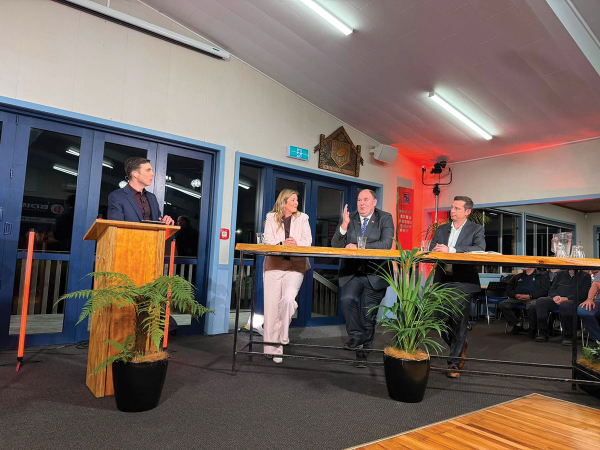 ACT’s Andrew Hoggard makes a point while Labour’s Jo Luxton (left) and Opportunity’s Daniel Eb look on.
It was billed as a chance for all the political parties to woo the rural vote, but question marks hang over just how effective this was.
On the morning of Sunday, September 6, just as New Zealanders were getting over the All Blacks’ defeat at the hands of the Springboks, the television programme Q&A with Jack Tame as the moderator ran an hour long special, which all party spokespeople on agriculture (except Te Pati Māori) turned up for.
It was wisely pre-recorded at a Hamilton sports club with an audience made up of locals of all political hues.
Those taking part were Todd McClay (National), Jo Luxton (Labour), Mark Patterson (NZ First), Andrew Hoggard (Act), Steve Able (Greens) and Daniel Eb (Opportunity).
Issues canvassed included biosecurity, the dairy industry and its effects on the environment, the Paris Agreement, free trade agreements, deregulation, rural health and the land tax. In essence, each representative trotted out their party line and it was difficult for those who follow rural politics to be any the wiser because of the event. Perhaps a rather startling revelation was Luxton saying that Labour has yet to announce its agricultural policy.
McClay defended his party’s stance on the FTAs while Hoggard was in jovial form, making a few quips at his opponents and promoting deregulation.
Patterson made some good points but looked a trifle nervous when it was pointed out that he was the first MP to visit India just after the FTA with that country was signed.
Able strictly followed the party line about the need to reduce cow numbers and claiming that this may not necessarily affect total milk production.
Eb defended his party’s controversial land tax policy which came under attack from others on the panel.
One of those at the event was regional councillor and former local Federated Farmers president Keith Holmes. He described the event as being well run and said Tame did a really good job in getting the politicians to state their point of view.
He says his impression was that there was quite a bit of intellectual horsepower on the panel, but noted that many of the answers to question were in the form of platitudes.
“What worries me is whether the rank-and-file voter actually understands the critical components that farming needs and the implications of some parties’ policies to re-engineer the economy,” Holmes told Rural News.
“I worry that people will vote on the basis of the platitudes and not the hard facts. To me, a move away from the present coalition would be a retrograde step,” he says.
He says the implications of the land tax were well exposed in the debate, but while he may have disagreed with speakers from the left wing, he noted they came across convincingly. He says, on reflection, the debate was more entertainment than being of any political significance.
Red meat farmers are welcoming Labour’s plan to review the Emissions Trading Scheme and not to campaign on pricing agricultural emissions.

For the first time in a quarter of a century, Federated Farmers has something positive to say about the Labour Party’s climate change policy leading into a general election.
OPINION: Get offside with New Zealand First leader Winston Peters at your own peril.
OPINION: Being a stock manager of a Government MP's farm can come in handy.
Election years are always a concerning time for farmers, according to DairyNZ chair Tracy Brown.


Surprised, humbled and quite thrilled. That’s the reaction of James Allen, one of the founding partners and now chief executive of AgFirst, on being made a life member of the Institute of Rural Professionals.
It was billed as a chance for all the political parties to woo the rural vote, but question marks hang over just how effective this was.
Minister of Conservation Hon Tama Potaka has appointed Susan O'Regan as Chair of the Queen Elizabeth II National Trust (QEII) for a three-year term.
Red meat farmers are welcoming Labour’s plan to review the Emissions Trading Scheme and not to campaign on pricing agricultural emissions.
Where any worker in the kiwifruit industry is mistreated, we expect the authorities to take action.
Mid Canterbury Federated Farmers arable chair, Bevan Lill, said Beef + Lamb NZ data indicated that for the last six years, the average arable return on investment was about 0.8% while inflation ran about 4% - so the average arable farm was going backwards at about 3% a year.